Episode 001
Adam Kilgore
Longtime General Counsel, The Mississippi Bar
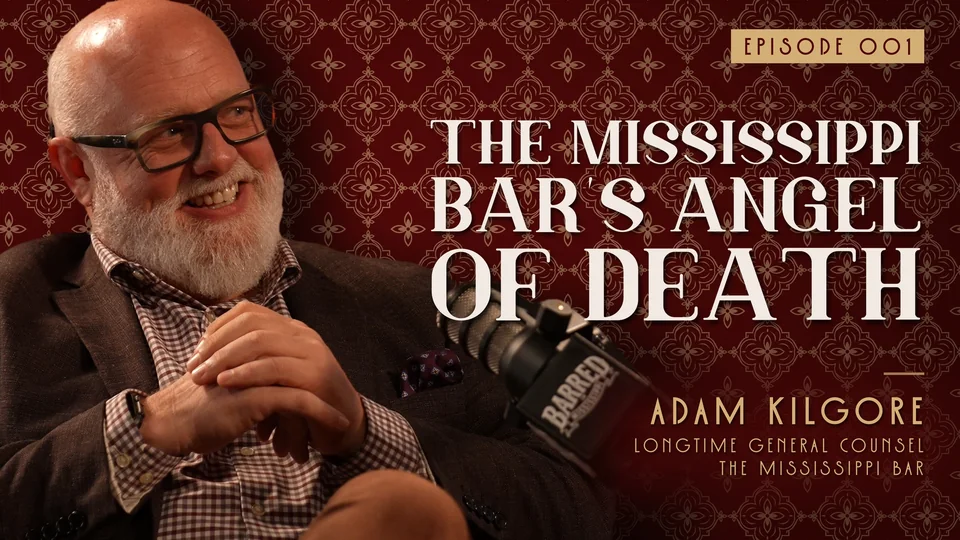
Adam Kilgore served more than two decades as general counsel to the Mississippi Bar, and he never planned on law. He wanted to be a sportscaster, worked in sales, and took the LSAT after a Myers-Briggs talk with a psychology professor. He clerked at the Mississippi Supreme Court and says being genuine wins interviews.
Full transcript
0:00Mike Frascogna III: Hey, welcome to this episode of Barred in Mississippi, war stories from Mississippi lawyers. I'm your host, Mike Frascogna III, and today I've got a friend of mine, Mr. Adam Kilgore, here with us, and this will be a really interesting weaving conversation. We've got a lot of things to cover. Adam is also a graduate of the Mississippi Christian University School of Law, short for MC Law. So we're a fellow grad from the same school. You came a little bit before me, but we have a little bit of a history between our firm and you way back. We'll talk about that. You have had a winding path to get to law school and into the practice of law, and then Adam served for over two decades as general counsel to the Mississippi Bar. So you're actually one of the best known attorneys in the state. For better or worse, the man is known throughout the state because of your service to the Mississippi Bar and your role specifically at the bar, as I like to say, as the angel of death, which we will talk about that too. I can explain that. Yes, we're going to let you explain that. Adam, thank you for being here. Really appreciate it. Thank you
Adam Kilgore: Mike. It's a real pleasure. I'm used to interviewing other people, so it's fun to be on the other side of it. I thought about preparing and I was like, well, you know, lived a life of preparing for this. So I'm very glad to get to talk about these things. I have been privileged in more ways than I can count.
1:25Mike Frascogna III: Well, and what you're referring to is your show on MPB in legal terms, which I was a pinch hit guest for my father about a year ago. And so I got to sit there with you and be questioned by you. And I have been plotting for over a year to get you in this seat so I can turn the tables
Adam Kilgore: on. Well, I'm glad to be a part of it and look forward to being forthcoming and all the ways. Very good. Very good.
1:51Mike Frascogna III: All right. So look, let's just start here. It's always a great start with any attorney. How did you get to the law? You know, what were you doing where you decided I might want to get, I want to go to law school. And then how do you pick a law school? Get me to the law. How did you get there?
Adam Kilgore: The law was never, ever on the radar. It was never on the radar. I grew up wanting to be a sportscaster. At about 10 years old, I made that decision and just started gobbling up information, NFL, Major League Baseball being the two primary. I certainly love college football too. And that was my focus going to college. I went to Mississippi College undergrad to do sportscasting. I did that for a time period and then transitioned to more of a communications business degree. So I have a communications degree from Mississippi Christian now, but it was in Mississippi College. After that, while I was in college, I started working at Penske Truck Leasing, which is off 220. So I was age 19 working for a Fortune 500 company and worked my way up with them. We'll probably get into it later, but I did not, I was not a good student. I've never been a good student. In fact, I'll tell you later how I learned how to learn. And it was much later than most people experience, at least in my opinion. So I felt kind of limited and that's all I could do. So I was in sales, I was customer service, you know, managed a department that, you know, had a, you know, a budget of combined probably 4 million of a sales goal. And I graduate college and, and become a district rental manager in the company. And we've got, I don't know, at the time, four or 500 locations. I was the second youngest person in that role in the company at the time. And it just left Nashville working for the youngest who was six months younger than me. And so I did that for a few years and then at about age 27, so this is eight years in, age 27. I just, this is not what I want to do for the rest of my life. I don't like the smell of diesel. There's several things related to that. And I do want to say, I, I'm, I really appreciate that time. And my father was a truck driver. So I have a great respect for the, the difficulty of that job. And I always appreciate my dad always was dressed up way more than a truck driver, you would think. And he just kind of carried a decorum with it. And I'm very proud of, of the, of the work he, he, he did in that regard. so at about age 27, I don't know what I want to do. And I, I, I, I mean, if there's anything that anybody's listening that I want them to hear, number one would be, it's never too late to reinvent yourself. You're not trapped. and so I, without thinking kind of went for it and the way I went for it was a friend had recommended, Buddy Wagner, a professor that is now retired, out at, Mississippi Christian, would let alumni come by and you'd get a, just a free visit basically with the psychologist. So I sat down with Buddy and I said, Buddy, I don't know what I want to do with my life. Very, very, you know, normal thing for people to say at various times. He was a psych professor. Yes. Okay. And so, and I, I didn't really know him that well. but, we had friends of friends and so we sat down and we talked and he encouraged me to take the Myers-Briggs personality test again. And I said, okay. And so I took it again. I'd taken it as a freshman. And of course, in those times, just be as honest as you can in the answer and the questions, you know, would you rather be gardening or watching a movie or, you know, just answer it. Well, it spits out like 10 things. And like number one was broadcaster. Yeah. Number two was politician. I'm like, no, no, no. And then about fourth or fifth, it said lawyer. And he said, well, you ought to think about this. And I said, Buddy, I did not have good grades in college. I worked 40 hours a week, partied almost that much and then went to school on, on occasion. And I didn't have a hard major. I did not have good grades. And he said, just go take the LSAT and see what happens. For the first time in my life, I had an academic success. I made a 150 on the LSAT, which is not anything special, but I recognized that the word problems were giving me difficulty. So I'm going to flash back for a second, 10th grade at Jackson Prep, Mike Kennison, who went on to fame as a Delta State head coach, hard teacher, hard coach. I had a mental block with algebra two. I would go in, do the work with him. That man met me nine, you know, for the last three, nine weeks, every day for an hour, I would get to school early. We would work on algebra and actually, and I couldn't, I couldn't get it actually graduated where he started giving me the test that morning. I would take the test in front of him, pass it, then go take it two hours later and fail it. And it was, I mean, demoralizing. What is wrong with me kind of stuff. And so that kind of stuck there. Well, I left in Jackson Prep and went to another school because I needed a little bit easier academics. I graded, I passed well enough to, he's smart enough to do this. He just doesn't know how to do it. I bring all that up because when I took the LSAT again, I realized this is just algebra. These are just word problems. And the things that Mike Kennison patiently, lovingly invested in me, it finally clicked. And I went from a 150 to a 160. And then you combine that with a low, PA. It didn't matter. Right. And so that's how I got into school. And, years later, I, called coach Kennison actually went and saw him up at Delta state and he just couldn't have been happier to hear from me. Absolutely. I remember you. And, that was just one of those moments out of seemingly hundreds that we as humans get to have where someone along the way gave a little extra. Nobody knew about it and it paid off. Well, coach
8:04Mike Frascogna III: kennison gave extra to a lot of people. I mean, the guy's a legend as far as just a high school baseball coach and then a college baseball in the state. I I'm amused by the fact that you go to this psych professor and you go, I have bad grades and I don't know what I want to do with my life. He goes, Ooh, law school. Yeah. That's, you know, I'm, there's probably a lot of people in our profession that have that same I don't know what I'm going to do. I'm going to law school.
Adam Kilgore: Well, and I'm sure we'll mention it at some point later, but I'm, I, you know, I now get to teach as an adjunct professor and I talk about graduating in the middle third of my class. Right. And it's important to recognize if it was in the top half, I would say that. It was like 38th percentile. So I didn't really learn how to learn. First year law school is very difficult for me. I had a professor rightfully tell me you might want to think about doing something else. Cause I've really just, my last exam, I hardly remember taking it. They actually handed me the exam. Cause I went to meet with the professor. I didn't recognize the handwriting. That's how tired I was. It was the sixth exam that first year. And I was just wiped. He said, what happened to you? And I said, I would, I just remember looking at the clock and remembering hoping there was another, like, I wish it was an hour faster. We'd all just get out of here and the professor would grade what they would grade. Right. And so that, that woke me up as, as you can imagine. And by my third year of law school, I had started to understand how I learned that didn't really kick in until two months before the bar exam. Really? And I passed the bar exam first time. Good timing. so I, you know, it, I had this, this choppy journey of not really knowing anything of what this meant. I look back at my resume, my life experience. It looks like somebody mapped all this out and maybe somebody did, but it wasn't named me. and so just very grateful and, and watching things coalesce. There's things from Penske truck leasing. I learned that I absolutely use today. There are things I learned from cutting grass as a kid. I absolutely learned. So I've just had all these along the way. And I mean, even the morning I took the LSAT, I was out in Clinton for that. And a man named Tom Coward walked up to me and saw me sitting there and just introduced himself. He's just a nice guy. He's a lawyer. He's, Oh, you're here taking the LSAT. Oh, I remember you. Cause you went to college with my daughter and he became a mentor along with hundreds, seemingly other people. So I could go on and on, but it's been those kinds of moments. So I just kind of found myself in places. Fake it till you make it is, is not the right answer, but it's like, what is expected. Do this, pay attention, try to lay back, recognize you're not the smartest person in the room. There are other things to learn. Even if you deem yourself the smartest person in the room, you're a fool. If you take that and decide there's nothing to learn. And so I, I, I had these moments on and on sales experience, customer service, very much played into how I handled general counsel.
11:06Mike Frascogna III: Did you, obviously you ended up at MC law. Did you consider anywhere else or was it only that?
Adam Kilgore: It was only there. My wife at the time was going into med school. We actually did the double at the same time. And, I remember people, I can't believe you're taking this gamble. And it was like, there's no other gamble to take. You, you, you, you throw it, you know, go for the long pass. It's time to go.
11:33Mike Frascogna III: So when you, when you went to MC, did you have, you're in law school now, you're kind of, you know, hacking your way through that at any point during law school, did you have a sense of what you wanted to do after law school or was the goal? Just, I got to graduate and I go take the bar and I'll figure it out.
Adam Kilgore: Combo. I certainly had interest in the work that, your father was doing and, and what you, you and your brother in this wonderful firm has, has been doing.
12:03Mike Frascogna III: Well, that, and that gets into, you actually did a clerkship here and that was before I was ever part of the firm. We'll get to that in a minute. But so did you, where was your sense of what you wanted to
Adam Kilgore: be an expert in something? And I didn't know what, and I kind of remember, I remember articulating that. It's like, just give me an angle, give me a niche. Let me be inside of something and really know the thing and not nothing identified itself. I was waiting for it. so I, I, you know, graduate, and I didn't have grades. Again, we're back to that. I interviewed with some folks. I interview well, I've create opportunities in that setting that not everybody gets to, but that can only take you so far. and I applied everywhere you can think of judges, et cetera. and then I got a phone call from a woman that had been involved with our youth group at church and she was a judicial assistant at the Supreme court clerking for, you know, for one of the justices and a mom of a good friend of mine from that same youth group was the judicial assistant for justice, Edwin Lloyd Pittman. And so I interviewed with justice Pittman and I got a phone call later that said, yeah, he wants to give it a shot. He's going to hire you. And I said, great. I, you know, thank you. And he said, he remembers your mom and dad from Sunday school and thinks a lot of them. So that's why he's hiring you.
13:32Mike Frascogna III: Nothing to do with you. Nothing.
Adam Kilgore: And I'm like, well, thank goodness it wasn't about the GPA. I hope he didn't see that. And so, you know, there was a smidge of guilt that I got the gig by virtue of knowing somebody. That's how this works.
13:48Mike Frascogna III: It does. And so I've never
Adam Kilgore: taken it for granted. I've never been haughty about it, but once you get that in that door, then it's up to you. Correct. Well, I, I, I do not want to say anything that would, that would sound negative to the law school. These were Adam problems, not the law school problems. I'm not sure I really learned how to write till I got to the Supreme court because I, we had hubby Saunders, who's a gentleman that may still be there, but he is very instrumental in the court. He looked at every opinion that was written and he would make some changes. I was there a year and a half. I don't think the justice Pittman ever changed a word I wrote. And I took that as a great compliment hubby did, but once it got to the chief chief justice, which is another point. So I'm there for two or three months and I'm working for this man who has served Mississippi greatly over 40 years of service, public service, elected official and chief Lenore Prather. This is 2001, 2001, 2000. ends up surprise loss. And so the next day we walk in after the election, we're recording this a day after election. So it's today in essence, walk in and I'm working for the chief justice. And that changes everything. Yeah. And so from there, I got some very unique experiences being inside of rooms, assisting the chief, hearing some conversations that most clerks don't get to, I got to bailiff the Supreme court. I was the guys. Oh yeah. Oh yeah. All rise. You know, that's fun formality right there. And you got to see the activity of that. So very grateful for that experience. So I did that for a year and a half. And once you've got chief justice on your resume, especially if it's the active chief justice, people are interested in that help. so I did, I worked there for a year and a half, took a job at a firm for seven months that just wasn't the right fit. And that's a weird feeling to get into a space. and, I may have, I've made a terrible mistake, kind of feeling, arrested development. If you know that show and show, it's very much that what
15:57Mike Frascogna III: what type of practice area
Adam Kilgore: insurance defense type of thing. And, it just didn't feel like it was me. Then I saw a notice that the bar was advertising an assistant general counsel position. And I was like, man, that'd be a cool gig. And so I, I threw my name into that at the job interview. and at this point
16:16Mike Frascogna III: you're what age?
Adam Kilgore: 20, I am 31, 31. So I went to law school at 27. Right. So I had a couple, I was a few years ahead of everybody else, but as you know, wide array of age at the law school, I, I was kind of the median age. and, I, you know, interview for the job. And I remember asking, I think this will play into what you're going to ask later at Mike Marks was my predecessor. He was general counsel. And I said, he said, do you have any questions? And I said, yes, tell me what it's like being in this position where you're in enforcement and other lawyers. Is it the equivalent of the NCAA walking into the room? And he said
17:00Mike Frascogna III: I said, you
Adam Kilgore: know, I've been paying attention to that Alabama and had some issues right around that time. And he goes, who told you I was an Alabama fan? And I said, nobody, I'm an Alabama fan. I grew up in Birmingham. You know, they were the home team in Birmingham. You know, all my family went there. I didn't, my daughter went later, went there. And, once the Alabama thing kicked, I feel like I got that job. So it's like, you know, my parents went to Sunday school with the chief.
17:26Mike Frascogna III: Yeah. General counsel
Adam Kilgore: likes me because I'm an Alabama fan.
17:29Mike Frascogna III: How can you plan stuff like that? And, and, and why would you apologize for any of that? You didn't have anything to do with either one. Well, and
Adam Kilgore: it's both instances. And maybe this is the lesson I hadn't thought of until this very moment. Be genuine, be who you are. Don't try to tailor yourself to something else. Yeah. Just be it. We are used to encountering people and going, Oh, wow. I love that. Ooh, that's weird. And going on. So just be yourself. And so these are a couple of instances.
17:57Mike Frascogna III: Well, and if you are, it allows you to fit more naturally. If they go, I want you and go, it fits nice. I don't have to try. I don't find myself in an awkward work environment or less than the chances of that.
Adam Kilgore: So, so, from there, that, that, that progressed to where I became general counsel of the bar. He retired after two years. I was 34.
18:15Mike Frascogna III: Were you surprised? Was this, were you surprised you got this job to
Adam Kilgore: begin with? Yeah. How'd you find out? Well, I, I remember it was, inauguration for Haley Barber as governor because we were on a walk, Mike and I were on a walk and he turns to me and says, Oh, and we're going to like check out the parade. And he said, I'm retiring. And I said, oh my gosh, okay. And he said, I'm going to recommend you for the position. And I said, Mike, you can't do that. I haven't been doing this long enough. I'm 34. I've been practicing law for three and a half years. Right. And he said, Adam, they may not even conduct interviews. They really like you. And I'm like, I had never crossed I get interviewed for the position and this is, this is a key point in my life, for a number of reasons. I get interviewed for the position. There are 10 or 15 people in the room, some bar presidents, several future bar presidents, several future judges. I run into these people on the regular and we still talk about it. And I'm so grateful. They will grab me and say, I'm responsible for this hire. And they did that for 20 years and they did it after the fact, which is very, very wonderful. So I'm in the interview. I'm letting it rip. Just like, like you're talking to like, man, I'm not getting this gig. Let's just be ourselves. So be it. Person important question. And I made a very important decision in response. I think it was Don Dornan, from the coast. He said, what makes you qualified to be general counsel? And I said, because I know what it's like to be falsely accused. a second. I have made the decision on the fly to tell them the worst possible thing that I've ever been accused of to then justify that I should be the ethics guy.
20:01Mike Frascogna III: And to be clear, the ethics position is really core to this position.
Adam Kilgore: Absolutely. You're prosecuting attorneys for violating the rules of ethics. Obviously there's an, so that has an enforcement component dealing with the public, dealing with scared lawyers who have, have this coming in and they may be legitimately scared because something's happened or they've done something or more, more likely they are just generically scared. And so he says, you know, again, what makes you qualified? And I said, because I know what it's like to be falsely accused. He said, what do you mean? I said, well, when I was in law school, I was accused of cheating to get on moot court. I was innocent and thank God I was found innocent. And I will never forget how I was treated through that process, which was mostly not good. An associate Dean was very aggressive after me. I had not done anything wrong. I ended up going to trial. And as I said, I was innocent and I was found innocent. There were buried things into that. There were, there, it was a good experience for me, despite what you would think. Obviously I got to use it later. but let's pause for a second. That's a pretty aggressive move to make. Let me tell you about a bad thing that I was accused of to justify why I would be good at this, but they, they, it connected because it was about talking to people and everybody in that room understood the fear of hearing from the Mississippi bar, right? And potentially getting a bar complaint, what the consequences are. And when something like that happens, you may not think straight. And so that related ability kicked in. And again, I want to be clear. It was all genuine. This wasn't a, was it a power move? Yes. Was it a power move where I've overt overtly thought in my head, now I'm going to play this card. No, it was me being genuine and I'm not going to be afraid to talk about things. So I explained, you know, again, the details are not interesting, but the mention of it. And so, I felt pretty good about that. I knew I'd made a good impression. I leave the room. I was told later after I was hired, somebody said, man, we sure do like that guy. he's really young. you know, there's probably not supposed to talk about it, but I think they actually talked about how old I was 34 at the time. And the Andy Kilpatrick, who was a former general counsel was in the room and they go, Andy, how old were you when you got hired as general counsel? He said, smiled and he said, 33 in age never came up again.
22:36Mike Frascogna III: I was going to say that probably, that probably not sealed it.
Adam Kilgore: Yep. So the next step is, is another, an important one. So I get hired for the job and, we'd already had an attorney leave separately than Mike Morris retires. So it is me and one assistant who I have just hired because the other assistant happened to move to Kansas, you know, wasn't related to the transition. It's just time to happen. So this is new blood, new blood. I've inherited an office. I got to fill two attorney spots in one to two administrative folks. And I've been doing this for two and a half, three years, three and a half years, one, two years at the very grateful for that too, because I got to handpick things. So I interviewed people. I interviewed more people than you should have looking back, but I was being very thorough in my last interview with one, with a person was the one. and we sat down and I looked at her and I'm pretty non-traditional in a job interview. I said, I think my first question was, do you like baseball? And she said, yeah. I said, do you know who Joe Torrey is? And she goes, yeah, manager of the Yankees. I said, do you know Don Zimmer is? And she said, I think he's the bench coach for the Yankees. I said, exactly. I said, Joe's been around. He knows his stuff. He's a former MVP. Zimmer knows more. He's been coaching longer, played the whole bit. I said, I'm not as equipped as Joe Torrey is, but I need my Don Zimmer. I need a bench coach. Can you be my bench coach? And she said, I love being number two.
24:08Mike Frascogna III: What an interesting question, line of questioning for, for an interview. What was it that, and in some ways it's brilliant. What her even being able to answer those questions in an intelligent, knowing way, what did that, what did that tell you? Why did it resonate with you?
Adam Kilgore: Well, it created shorthand because I need someone by my side that I can trust that will guide me and tell me. And, and I made very clear. And I hired another person too, that had more experience than me. So I basically hired my mentors. but what it told me, number one was that there was some shorthand that we could do pretty quickly. And if baseball had not been her thing, I would have shifted to music, member of a band, something that could create that same dynamic of discussion. Right. and, but yeah, I think it was shorthand and the conversation went with both of them. I said, I've hired you. I am the boss. You are my mentors. I need you to say no. I need you to say yes. I need you to tell me exactly what you think. Do you promise to not hold back? They both said, we will not hold back. I said, okay, followed up. I need this. Even though I've heard every word you said, I may go against your advice. Are you going to be okay with me going? Heard you? No, we're doing it this way. Right. They said without hesitation. Yes. I probably went against them three to five times over a 10, 15 year period. It was probably right two to three of those times. We weren't trying to keep score. It's all about the result. It's all about big picture. Right. So, that's kind of how I formed the team. And that has been an approach I've done ever since. The other piece to it was, I know, I don't know as much as the people that are calling me at the bar. I'm the young guy. I've got some nice things that we can point to, but I'm an unknown. You know, my dad was a truck driver. We weren't from here. I moved here in ninth grade. we, I'm not related to any of the Kilgores in Mississippi, although I get asked a lot. There's a few in Philadelphia and throughout the state and I claim them if they'll claim me, but we're not as far as I know related. And so, in the midst of that, it was like, what needs to happen? And I felt there was a disconnect with lawyers in Mississippi. And I think this is probably everywhere or may have been at the time. I'm scared to call the Mississippi bar with my issue because I might get in trouble. So people weren't calling with legitimate ethics questions that would help them. Meanwhile, I come from a customer service background. what I'm good at. I know how to do a little bit of crisis management even. And I've certainly after 20 years at the bar, very much am skilled at that. and so I just went with what I knew what to do. And that's kind of the lesson here. It's like, go with what you know, and then figure out the rest. And so I just made it a very customer service driven approach us, talk to us. We are real. We will shoot you straight. I always tell people, I can't, I'm not going to give you a stamp of approval or disapproval because we're not allowed to do that, but I won't hide the ball. It'll be in code. Something like I wouldn't do that if I was you
27:23Mike Frascogna III: is a pretty strong
Adam Kilgore: code language there. And, and so it built up credibility. I'm very good at public speaking that created credibility. I'm grateful for that, that communications major and some other experience certainly, drives that along with some natural talent, which I'm grateful for. I relate to people to a, to a point in the audience where I could see the eyeballs and know I've got them. Same thing with law school class. And it created such a connectivity. They felt like they knew me even though I hadn't talked to them yet. And you know, I
27:58Mike Frascogna III: thought it was interesting. You told me, in a previous conversation and it goes to what you're describing as far as the, kind of the attitude towards the bar from, from the Mississippi lawyers. You said nobody wanted to call the bar. It'd be like calling the IRS with a tax issue. and I think that's, it's scary maybe on two levels. Number one, you you're the enforcement arm. I don't want to, I don't want to have any communication with you at all, preferably. And then to the customer service. I, do you expect to get good customer service when you call the IRS? No, you don't expect it. You don't even know if you can get anybody on the phone, much less get good customer service. So it's probably the same thing with the bar. And what you were able to do was flip that and say, no, I'm, I am here to speak to you and I'm going to be polite and we're going to be friendly about it. I'm going to give you the information you need. I'm kind of on your side, you know, as long as you're, you know, in between the rails, I'm on your side. Absolutely. And, there's also another
Adam Kilgore: layer to it too. Most of the time you're talking to somebody that knows more about their practice area than you do. So you have to be genuine. You have to be credible. You have to not be afraid to say, if you're talking to somebody about, you know, domestic relations or a divorce and, and they're talking about, I don't even remember the number now. I think it's a 503, you know, it's like, okay, remind me what that is again. And there will be times where people would look at you and go, well, you're general counsel. So you know everything about the law. And I'm like, no, I have a 10,000 foot view. I understand some things maybe the typical lawyer doesn't, but from an expertise standpoint, I've only got one and that's ethics. So even to this day in representing clients, all right, tell me more about that. You can't worry about not looking smart. The, the people that don't look smart are the ones that don't ask the question to try to understand. Now, if you're having to get trained on something and you haven't done your work on it, then that's a different conversation. But shorthand, making sure if you're talking to a bankruptcy attorney, we talking seven, 11 or 13, and that's about all I know. That's okay. They are happy to tell you. So, so yeah, it started to increase communication. and I put it in the category of prevention. I always said, we will never have a ledger that tells us how many things we prevented. Good point. We'll never have it, but we will see at the end of the year, what discipline was there. And, and there were jurisdictions out there because I was involved nationally at the time. And in the two thousands, there were people out there that it was more about skins on the wall. How many disbarments can we get? I remember overhearing an attorney from a state. I won't mention bragging about taking something that was a minor violation and on a whim, taking it to trial and disbarring a lawyer and celebrating it. I'm like, man, what is wrong with you? That that's not what we're here for. That's the, actually the kind of stuff somebody would need to look at. and so I, started being a bit vocal in the national organization of bar council and just talking about how I did it. and I knew I'd had some impact, but years later I came to find out when I was leaving that the Mississippi approach was, wasn't just me. It was other people working with me, including our current general counsel, Melissa Scott, who I had as a later on, she was another, she was younger than me and a mentor. We had the same relationship, law partner. I get the final say I went against her two or three times over the years. I was right. One or two. but you, you know, you, you, you end up building that type of credibility and accessibility and you can do a bunch of magical things and really change some things. And from a, from a national standpoint, it's my understanding. it's more about prevention now than prosecution. We're still going to prosecute. I remember sitting with an attorney once in a hearing. We used to do investigatory hearings. I think I did about 500 of these over my 20 years. And in this particular instance, this lawyer was, had some pretty serious accusations and was denying them and was talking about some of the social components, where he worked, where he came from underrepresented community. There were a lot of pressures on this person. And I looked at him and I said, listen, I, you know, what you're talking about is what we need to be as lawyers. And, you just keep shooting me straight in my, I'm right here, man. There's my hand. It is open. And if I find out your line to me, this becomes this, and I will hammer you. And that's actually what happened there. And it never took joy in that, but that's what happened. But we had plenty of good, well-intended people that made a mistake. It just needed to get corrected. And then we had some bad actors.
32:56Mike Frascogna III: Well, so let's, let's talk about that because I jokingly referred to you earlier as the angel of death. And so that is part of the job description of, there are some that go too far. They go over the line and, nothing, all the preventative measures that you may have taken, it doesn't work out. And so there comes that point where the open hand does have to become the fist and you take the sword out and you've got to administer justice. Talk me through what does it take to get to that point? And then really personally for you, what, how does that feel to you when you go, I got to make the call? I've got as in not both the decision and I have to pick up the phone to call this attorney.
Adam Kilgore: Not nearly as hard as you would think. Jim Clark was one of my mentors. Gwen Combs was the other one. I want to name that. And Jim passed away here in the last year. Jim had a phrase. He said, we don't go after anybody. They apply for it. And it is just so accurate. It was always the case. bar complaint would come in. I think they're now called a grievance, but that, that would come in, it alleges certain violations. Attorney has to respond process starts going. If it eventually gets to a serious violation, we would go to a formal complaint where we're prosecuting them throughout that you're seeing what they've done. And someone has intentionally forged a judge's signature to try to satisfy a client because they never really filed suit or they never really, this deposition never took place. Whatever those things are. That's easy. That's happened at more than once. Yeah. Wow. And it's not just happened. This is where that compassion can kick in. there are good people making bad choices. one, the one lawyer that comes to mind. And again, there were more than one instance of that forged, forged, forged a judge's signature was a paragon of virtue in his community. everyone was shocked. He was ashamed. He just got under the gun. We are all human. We are all subject to that condition. he got behind and he made a bad decision trying to satisfy a client. So he forged a judge's signature, not for it to be filed in court, but to send to the client until he could get it right. The client went and filed it at the court.
35:23Mike Frascogna III: Oh, wow.
Adam Kilgore: And so that's how it spun out of control. Multiple instances of that, even with the compassion of, Hey man, he wasn't in a good place, made a bad decision. It's still easy. You, you have, I mean, you violated so many rules here that of course, we're going to go. so that actually was not as big a problem as you would think. in most of the time I was using compassion, even with people that had committed a violation, unless they were so difficult to deal with fighting us at every turn, not being genuine. If they were being genuine, I would shoot them straight. I, I used to, I didn't do it for disarming purposes, but I did recognize that it would happen. If we were going to trial, I'd walk up to council's table, introduce myself to the person that was the subject of the complaint. How are you doing? Hey, I know you, you know, you're not, you were, you're friends with so-and-so. So am I, Hey, I know you're a football fan. How'd your team do this weekend? My Cleveland Browns are still terrible. You know, whatever those conversations are, it disarms, it defrosts, but it's also sincere. so it's, you know, do sincere things. And if it's got another by-product, enjoy that as well, but it disarmed things. I actually became friends with some people we disbarred. Really? And I did not know them, but for the process, not, you know, not close, close friends, but certainly not enemies. I mean, did some social things together. Wow. I, I always took that as a compliment. I am certain there are some hard driving folks out there that could have taken it as you're being too soft, approachable and accessible is going to win almost all the time. And then you back it up with what else you've got to do. But, there was a couple of times where we celebrated some folks. There was one lawyer who was, I referred to internally as a scourge of the profession. just really, representing folks that were, less educated, less sophisticated. and, and I hate those terms, but it's just what it is. and would, would take a fee and then not do any work, not answer any questions. And it just went on and on. And it was a, it were folks that not necessarily would appreciate or pursue filing a complaint. So it was, you know, used to talk, people would come up to me and say, Hey, you know, so-and-so is doing dah, dah, dah, dah. Y'all need to go after him. And I couldn't even talk about it. But in my mind, I'm like, somebody's got to file a complaint. We don't have anything on it. I've always been of the belief the cops know who the bad guys are. You've got to have the evidence to do it. And so this, an interesting point for lawyers, lawyers understand. We've got to have proof. there's a burden of proof to me, not when it comes to a bar complaint matter, they can't think straight. It's like that person's doing this. Y'all need to take them out. I'm like, they've got due process. Just like you do. It's going to take a minute. We actually have to have the real case. And there were times where we just, we didn't have
38:25Mike Frascogna III: it. Is that, were there any instances you described one where you somewhat celebrated the guy that was the, as you said, scourge of the, of the profession, anywhere they were maybe there's a really difficult one that, man, that's a, this one, this one hurts. This I, I can't believe we're going to have to go this route, but it's, it's the right call.
Adam Kilgore: Yeah, there is. but telling the story. I just want to tell it in the right way because it was very difficult for a person. and I don't want to even come close to disclosing. there had been the subject of, of some physical abuse from a client, and had been put in a really awkward spot and the lawyer did not come clean about it. And so we were going through the process and not getting a ton of participation and it didn't come out until the morning of the hearing what had happened. Oh, and I was not working that case that my two deputies were, but they came and spoke to me and told me what was going on. And we basically stopped that trial from going forward and intervened in a different way so that we could put this person in a better posture to deal with what the consequences were. So you have a bad thing happen that results in, in some other things happening because a person is depressed. A person is in turmoil internally. and there's gotta be a space for that. So one of the mechanisms we had lawyers and judges assistance program helps people that are impaired, alcohol, drugs, depression, do a wide variety of things. We were able to steer that person towards that program, let them get in a better place to deal with it because we still had consequences from neglect of a client and that had real outcomes that mattered. And so that, yeah, that that's tough when you see a sympathetic situation and you still have the obligation to do it. But at the same time, we were able to put this person in that posture where they got the help that they needed. And that happened at least a hundred times where I would sit down people. I went to law school with classmates that were not okay. Alcohol, drugs, depression, and had that moment with them. And so this is when people talk about being lawyers. This is when I start talking about and using a word that, Gwen Combs, my deputy coin said, "We are ministering to the needs of others." And that ministering to the needs of others is not just your client. You can be in enforcement and in the scariest thing available to a lawyer and meet that person where they are, treat them with dignity and respect and compassion, and find a right way to to get things to go forward. And having been a part of seeing people change their lives, alcohol, drugs, depression, whatever it was, and just being at that front door and then understanding larger judge assistance program in the bar and the, and the office of general counsel do not communicate unless there are certain agreements made. So they don't know who our customers are. We don't know who theirs are. As you can imagine, sometimes those two sync up, but getting to be there with somebody like that and get them in the right place or towards it, or give them the opportunity, and you can't ask for anything better. That is life-changing stuff.
41:59Mike Frascogna III: You you have, you sat in a very interesting seat in the way that you got to see attorneys operate in the state of Mississippi. You see a lot of this behind the scenes stuff that the public doesn't know. What is it that you think the general public mostly gets wrong about attorneys?
Adam Kilgore: That, so, you know, I saw the worst of the profession, and I will tell you, the good lawyers that care, that donate time and resources and expertise far outnumber the bad, bad actors that I dealt with. It's not even close. Seeing people run through the bar center, serving on one of 27 committees. I'm making up a number, but it gives you an idea. I got to liaison to four or five of them. Ethics committee, committee on professional responsibility being the two main ones, but some others. And seeing those people dedicate their time and how much they care about it and how honored they feel to get to do the volunteer work with the bar is one way. but numerous other ways. Yeah. So so the lawyers, you know, are there bad actors out there? Are people out there trying to make money? Yes. are lawyers too busy? There's a bunch of yeses in there, but there's also, there's just a lot of gold out there. I mean, there are folks that just take the counselor component seriously, the meeting people where they are seriously. And so, you know, do your homework, try to find out if you're wanting to hire a lawyer. That's a bulldog. You're probably not thinking straight. That doesn't mean you don't want to have somebody that will fight for you, but this whole list, you know, they're going to go after them. They're going to, divorce is an easy example, but sometimes this happens elsewhere. Clients are litigating their feelings much more often than the actual case. And so if you're going to hire a lawyer, that's going to litigate your feelings for you, you're probably not going to get a good result. It's probably going to cost a lot more. And whatever was left of the relationship that existed is probably frayed beyond repair by virtue of taking that aggressive approach.
44:11Mike Frascogna III: I think that's a great observation of you're not, you don't want to hire somebody that's going to litigate your feelings because there's almost no end to that process. You're just going to spend a lot of money. There's, it has nothing to do with the underlying facts and that's what's either going to successfully settle this out or not. So I've never heard, I've never heard it put that way, but I think that's a great way to look at it. Do not hire somebody to litigate your feelings.
Adam Kilgore: And it's hard for people to recognize it. And, and I've been surprised. So now I represent attorneys, in, in various matters, usually ethics related. 98% of the time, even if it's a lawyer that's been well established, I have to get to the emotional component of what they're feeling related to what's going on. Most of the time it's because they've never been accused of anything in their life, which takes us back to the accusation I felt in, in law school and why I'm grateful for it because it's created that relatability. And so I've even made the mistake a couple of times of not mining that area with a client who happens to be a lawyer. And I found it to be a mistake. And so finding that space, getting them to articulate what it is that's bothering them. You may not eliminate the bias, but you can at least put it to the side. And then suddenly you as a lawyer, me representing them, I have this resource, which is another lawyer that knows their case better than I do because they've lived it. And I get the benefit of their brain on it as opposed to immobilized client.
45:43Mike Frascogna III: Right. Well, that's, as far as what you saw with, with the attorneys throughout the state, it's a unique, it's unique profession because we're governed by, you know, a code and a set of rules and ethics. and it's a profession where largely people are just coming to dump their problems for solutions. It's a lot of pressure there. Now, not every area of law is like that, but you know, largely speaking, it's a, it's a high stakes profession in what you're dealing with, dealing with very emotional issues with other people. How do you see that impact the attorneys here in the state? How are they coping with that?
Adam Kilgore: Well some of them aren't. And that's why our our profession is twice as likely to deal with alcohol, drug addiction, and, and, and potentially suicide. And so that's, again, I plug the law.
46:34Mike Frascogna III: Twice as likely as what? The general population. Yeah.
Adam Kilgore: This is based upon a book I read 15 or so years ago that York Craig gave me when he was bar president. it's another wonderful man. the bar presidents are a whole nother conversation, maybe for another day, but a wonderful to, to, to see the world through their eyes. but yes, lawyers are twice as likely as the last I read. and I would think that's still the same. so, you know, we're, we're carrying other people's stuff plus our own, whatever that is, and whatever stage we're at in life. and there is, again, it's about trying to create that relatability when you're interacting with them, but yet lawyers have to find some boundaries. It's not too far off from when I find out if a loved one has died or if, you know, a friend of, you know, a friend just had a loved one die, or maybe a friend is in the posture where they're going to be the primary caregiver for a period of time, or they're managing this until things settle down. I'm never worried about the sick person. I'm worried about the person that's taking care of them because everybody else is worried about the sick person. So I'm hitting that person and we can call them a lawyer too, because it's kind of the same thing. How are you doing? Are you hydrated? Are you eating? Are you sleeping? Are you exercising? These are the four things that go away when we're under duress and the further they, you know, they're not attended to the worse you're going to be and you're going to crash. So are you doing these things? I don't live a life of doing that well every day and I'm not under extreme duress, but I, but I think it's a lot of the same thing. So as a lawyer, we've got to have a, have the ability to, you know, deflect some things off and not let it bother us. I don't know how some people do it. If I was in child protection services, no chance. you know, the radio show we had, about a year ago, Mr. Jordan, ended up being, executed. We had their lawyers on the show 30 hours before his execution and we weren't there to debate the death penalty. How's this work? What's this like? And hearing those lawyers talk about the burden they were carrying of this relationship with this man they represented followed by hearing that man explain, you know, what is Mr. Jordan saying here in these last hours? He's just so sorry. He's about to leave and how much it's going to hurt us. That was, that was his focus. He's just worried about us. He's being put to death and he's just worried about us. So again, we're back to that human condition. Let's find that space, but we, you have to protect yourself and make some good choices. And sometimes that means you may be flipping about something that is very serious because you need to protect yourself. we had gallows poll humor in, in, in our committee meetings about discipline because at some point it gets so heavy. We just have to call it like it is somebody making inappropriate, you know, comment briefly as a joke, break the ice. So we get back to business there. There's a healthy space for that. and so I hope I answered your question, but that's kind of all the around the things that, you know, I think we as lawyers need to do and, and kind of maneuver through, but in humans need it too.
49:54Mike Frascogna III: Yeah. So interesting that while, you're a general counselor for the bar, you are also serving as the fitness director and nutritionist for all the attorneys. Despite not
Adam Kilgore: embodying that. Yes.
50:05Mike Frascogna III: So as, as, as the, the legal community is, is dealing with all those pressures and then you're overseeing all the kind of the pressures that, you know, of the, the body of, of lawyers in the state. at, at some point you decided I've done enough here. I'm, I'm hanging it up. I'm hanging it up as general counsel, the bar. How did all that come about? How did that decision get made?
Adam Kilgore: Some of it was, survival. And I, again, I'm so grateful for my time at the bar is not, it is not, it's not me complaining per se, but there is a burden, you know, just being in a position that long has its own, you know, it, it makes things easier. It can make things harder depending on, on the topic. the pandemic hit about four years before I retired and the customer service component to that, was so much more. So, you know, one piece of my job we haven't talked about yet when I was general counsel is interacting with the public, which has got a similar set of rules, but a few different ones. And so let's just look at how things have heightened. I became general counsel in 04. How different is the world? Public's expectation, people's, anger is just below the surface if it's not the surface. And so, and then you throw in the pandemic, you throw in, emotions related to, George Floyd, emotions related to January 6th, both things that not necessarily I'm dealing with in my office, but are driving so much. and so it became a customer service nightmare, especially during the pandemic. but, after that too. So there was frankly, just out of gas, just, just out of gas. So that, that was the decision, but, I did not appreciate what to, to the full degree. We, we all need our, you know, the step away to do it. And, I, I am triage trained in, in dealing with folks and in the thing we hear it all the time, but I'm here after 10,000 phone calls from the public, I'm making up a number. People just want to be heard. They just want to be heard. And we have things running so tight in so many arenas, whether it's a business or, a, a, branch of the government or some entity that operates under the government, you know, you know, some service that, that, that, citizens are provided. Everything, everybody's running tight. meanwhile, we, as customers are more likely to talk longer or, or, or, or save more things. We're more likely to express our feelings. And there's a lot of taxing that is going on there and we're losing some valuable time because you have to take care of this person. And so sometimes people make the choice of, I'm, I'm not going to invest that time. It's just like, they're going to just have to deal with it. I am not going to be approachable. I've got too much to do. And that is defensible. It is absolutely defensible. I also think it's the wrong approach that, that you're missing out on some investment that will pay off later. You've never seen. And I've certainly made my mistake. We had one person that was mentally ill calling from California, complaining about a California lawyer, but they kept calling the Mississippi bar and they would leave these long messages overnight. And, I finally decided to call this person to just try to shut it down. I'm like, I'm going to listen to them. I talked to that person for at least an hour. They had something related to an, a car crash, an injury. They didn't like the way the case went. It was long ago decided statute of limitations long gone. There's no relief. And so I recognize this person's in physical pain. They maybe have some mental issues and somehow in the conversation, Lord of the Rings came
54:03Mike Frascogna III: up and I'm like, you
Adam Kilgore: lord of the Rings fan. And he said, yes. And I said, so, and forgive me for those watching that have not go read it and watch it. there's a component there where the burden is heavy for the ring bearers and their job is to take this thing and destroy it. And it takes you over. And I said to him, so you remember, you know, Frodo Baggins gets all the credit for carrying it. Sam helped at the very end, but you know who gets, should get the most credit doesn't get any as Bilbo Baggins because Bilbo didn't have it stolen off of his finger. Didn't have it. He set it down and he walked away because he knew it was time was over. And so I, I, I use that to try to reach this person to say, Bilbo, it's time to put the ring down. This is somebody else's burden. There is nothing else to carry on this. It hurt. It mattered. It still hurts. There's nothing else to do with it. Put the ring down, be Bilbo Baggins. The next day he called, I mean, I'm proud. I walk out to my staff. I'm like, guys, I mean, I just hit a grand slam, buddy. Next, next morning I come in another long voice message from him, just like before I call him back. He does not recall the conversation. Oh, it's so it taught me. It's like you can go the distance. And I did. I gave more time than I had available and I wanted to bring that person comfort. And maybe I did. I'd suspect I did for that moment, but it did not last. So some of these things we do, you just go do them. And the outcome is almost irrelevant. It's like do it the right thing for the right reason, help somebody, make them feel valued because most everywhere else they're calling, they're not going to feel it.
55:48Mike Frascogna III: Wow. That's a, that's a really interesting story. And I guess what you realized the next day when he called back, it was almost the the lesson in reverse. It was like, Hey, Adam Bilbo, it's time to set that ring down. There ain't anything else you can do with it.
Adam Kilgore: Yep. Yeah. And so that actually did lead to me being a little bit shorter on calls, but you can still have the component of all this. And so, you know, fast forward years later, I'm retired. I didn't, I just did it to do it. I mean, I did it cause it's the right thing to do, whatever those answers are. I would get 10, 12 phone calls on a Friday and it would be 30 minute increments with lawyers and it's happening so fast. And I'm triaging a lot of didn't catch their name. that has resulted in people hiring me later. And they're like, Adam, I spoke to you on my hardest day. I'm like, I'm sorry. I don't remember talking to you. No, it's okay.
56:44Mike Frascogna III: Cause it wasn't your hardest day. It was their hardest
Adam Kilgore: day. He's like, you, you, you walked me through this, brought me calm. I was not okay. And that is actually led to business. That's a beautiful thing. I've lost it. Same thing. I was in the class and I heard you speak and I just really related to you. And I mean, you know, this is not bragging, this is celebrating and I'm just so grateful. So, you know, again, go forward, do the right thing, follow the, follow the process, follow your heart, be genuine, approachable and try to find a path. It's not going to work for everybody. Yeah. There are people that did not like me either because they thought I was cocky or didn't like my style. Some people didn't like me just because of where I worked. Sure. If that, if you want to be that intellectually lazy and go there, go right ahead. I'm not going to worry about that. but I would win people over not because I was trying, but I was just being myself, being myself. Well, I'll
57:37Mike Frascogna III: tell you what, you're an Alabama fan, but you may not be aware you're actually following the, three Lou Holtz rules for life to a tee, which is, do what's right, do your best, show people you care. So you pretty much nailed it. That's how, that's how you're, you're actually a closet Notre Dame fan. I'll take that
Adam Kilgore: compliment. I don't, I don't mind, you know, I think rooting for the second best college football program of all time in Notre Dame would, would, would be okay. We can add them to Alabama. Let's move on.
58:07Mike Frascogna III: Let's move on. So tell me about your practice. Now you, you, you've left the bar after over two decades. Now, what are you up to now? What do you, what do you decide to do after being at
Adam Kilgore: the bar? Well, it's, it's interesting. I didn't know what to do and, and, things were so busy at the bar. I was actually late leaving my last day. we were at the end of 2024 and Melissa Scott Missy was going to start the next year. And so we were trying to finish up the letters, administrative letters and, and it is five o'clock and I'm looking at her. I'm like, I cannot believe you're not going to let me leave. And she's like, no, you got about 30 letters left to sign. So I've, I've signed it. So I was late leaving. Point is I was so busy, you know, transition and, and just wrapping things up that I didn't have much time to plan. It was like, I'm just going to retire. I don't know. My, my first thought was I'm going to get a, a chair and go park it at, a busy intersection and just watch people go to work. That didn't happen that way. I was actually in federal court because someone had hired me as an expert. So I was working January 2nd. I was up, I think the first Monday was January 5th. I was up at 5 AM on my first day of retirement and went and got into court. as far as the work I've done, I do a lot of, of, representing people in ethics related matters. Sometimes that's bar complaints. sometimes that's an ethics expert inside of a case, which is a surprise to wake up one day and realize you're an expert. I, you know, it was like, okay, that makes sense, but wow, that is that, you know, again, I wasn't shooting for that. I was just doing my work. I have, graduated to some other things, bar admission work. I'm representing students on character and fitness matters before the bar board of bar admissions. And to be clear, I never worked with them. That's a separate entity. and it has been rewarding. I know almost everybody in the room. So there's an, a, there's a comfort level there. And again, ministering to those people's needs, a person who's had a minor in possession in college or maybe more than one of them and how that's impacting their application to the bar. And there's some hard things that can happen inside of that. And inside of that, we actually had someone that had no idea they had an impairment issue and is now one year in sobriety sober. And I got that met buddy, not for you, but, but you know, text. And it's like, I wouldn't have done this without you. I'm like, buddy, it was all you. I was glad to be there to hold your hand for a second in point. Cause that's all it did. that I'm hosting the show on MPB in legal terms, which is its own reward. And, we're, we're trying to demystify the law for the public. help people understand how the system of democracy and justice is supposed to work and will work again. And then third, I'm trying to instill some civic responsibility because we need to vote and we need to do more. And, we need to be good consumers of the services our government provides, hold them accountable. But if you went to take your kid to get their driver's permit or driver's license, and you did not bring the report card and the birth certificate, you are the problem, not the good public servants up there. You're the one that has made the line long. No politician is going to stand up and say this and get elected. So somebody has to say it. So I've not beaten the horse too bad, but it's like, we need to be good consumers. Look online before you go to make sure you've done what you're supposed to do. Don't hold up the line, be considerate.
1:01:40Mike Frascogna III: Well, given your background, I, it's, it's not surprising to know that you are, you're also doing a lot of work in ADR. So tell me about your ADR. Yeah. It's, it's primarily been teaching and teaching.
Adam Kilgore: Yeah. Teaching is my primary there. I'm going to, you know, I plan to get into, ADR down the road, but I have, in my second year of teaching alternative dispute resolution at the law school at MC law. and very grateful for that experience. people go after that stuff. They actually called me and, and as a, person who had just left the bar and am used to having a place to go to, I really felt like I was retired football player that they hired for this one special assistant position. and you know, they didn't have my number up in the stadium. They don't have to, you know, but it, you know, here's your parking, you know, card, here's this, you're welcome here. Anytime has just been such a gift. and so in that experience, I was empowered by the Dean to teach that class the way I want to teach it and that we've got your back. And he said to me specifically, you're here because you've been out there and you can give our students something, our faculty can't. So do it. And so ADR is complicated and fascinating and there's a lot of pieces to it. And it also can be taught in about 30 minutes potentially. Now you'd need to dig some more, but really we could do this in 30 minutes. So I sat down with my class and I've done it with both classes, but you know, we get better each year. We do these things. I told this year's class. I'll be even better next year. Sorry you missed out. cause I think it probably takes three years. We're just, this is about people, people that are scared of AI. This is about people. The lawyer's ability to do this is what's going to matter. It doesn't matter that you have the answers AI wise or may have the answers, however that looks. And I'm sure that's going to get more refined and accurate as time goes on. It's going to be about this. So, so much of what we're talking about in my class is people, we're talking about reading people, not profiling in an inappropriate way, but picking up this little nugget and go, Oh, this may mean this. So they might do that. We actually went around the room a couple of times. I overshared with them and told them they can't share at the same level I'm sharing because that would be inappropriate, but I'm going to overshare things about me for purposes of vulnerability and genuine and being genuine. and we went around the room and I asked them to tell me one skill or talent they have that they're really proud of and one they want to work on. And that morphed into different conversations that were way far afield from that question, including things like someone saying, well, I was the oldest child. So I had this role in the family and my mother wasn't doing so well. So I was kind of raised them a little bit. And then we started going around the room and then we found out who, where everybody was in the packing order of kids and what role they played, came across a couple of the only children, which I am mostly one of a stepbrother and stepsister that never lived with me. So I am an only child. Two of those folks were also military kids. And I asked them where their hometown was. They said they didn't have one. And I said, class, stop for a second. How many of you don't have a hometown? Think of these things. So it's, it's, we're just trying to get to the relatability point. I heard brilliance from my students. One only child in there said, so what is only child meant to you? And they said, it's tough watching people not appreciate and nurture friendships because I didn't have siblings. So these are my brothers and sisters and watching my brothers and sisters not get along hurts me. And so it just, it created this space where I can at any moment grab onto, pull back and go, remember this, remember that, you know, what are the, you know, managing the feelings, manage all these things like, when are we going to get to the ADR? This is the ADR. This is how you do it. You've got to find a way to relate, pivot, still be yourself, make some judgment calls on what you picked up information wise, followed by being able to pivot almost immediately because it does not look like you think it does. And, and, and go along the way, stay intellectually curious and, just enjoy this thing of humanity that we've got where we get to interact with each other, find that space. And so I, my classes just responded so well. I'm so proud of them. I tell them every week because we're being brave and we're talking about some things that, and admitting some things.
1:06:23Mike Frascogna III: Well, it's certainly a, a, a, sadly a dying skill of that ability to sit and interact and mine things from the other person that help you connect better. I mean, I go back to the example that you gave with the, crazy person from California calling the Mississippi bar and, you know, having a conversation with them about Lord of the Rings. Cause that's what they, that's where you could meet them and you could interact in that space. I mean, I think there was a lot of skill on your part to take the strangest call you could get and actually get there, but that's the type of stuff you're teaching these, these students in ADR. So let me ask
Adam Kilgore: they're siloed, you know, I mean, they've, they've been living that and, and, and one other thing I've been a little disappointed on, and I'm going to lovingly encourage my students going forward. They don't have other outside interests. It's all been that one thing. I like to ask the room, you know, what are your, what are our talents here? I want to know if there's a black belt in the room. I want to know if there's a baseball player. I want to know, I want to know, I want to know. And I go around the room and there's hardly anything, which is, which I found disturbing, but I've been sure to not communicate to that, to them in an inappropriate tone. What do you, you haven't done? What do you attribute that to?
1:07:32Mike Frascogna III: That's kind of, that's odd. Well
Adam Kilgore: I think, and I know you're well versed on this, so I'll defer to you, but my gut is it's similar to making a decision that your kid's going to only play one sport and just get great at it. And you don't get the versatility of, of, of, of playing multiple sports. I even heard something Nick Saban, came across yesterday. He, used to recruit defensive backs that were baseball players for two reasons. Number one, they knew how to track the ball properly. so number two, they played baseball. They're used to making multiple decisions because, you know, despite people thinking baseball is boring, it's the most active game out there from an individual standpoint. There are so many choices you're making. Even if you're just in the field, what's the count? Where am I moving to? Don need to shade this way. This scouting report says this, there's all that going on. And plus the physical skill of being able to catch the ball. So we, we lose that cross training ability. If we don't have another interest, I've been taking guitar for 20 years or should I say it's been taking me. I'm not a very good guitarist. I'm making headway. I'm not sure I could still play a, sit down and play a full song, but I can do a lot on it. And my teachers taught me I've had to overcome bad hand eye coordination issues. And so just me holding the guitar successfully is a success, even though I've not felt successful at times. And I'm this close to busting through and my teacher and I, we, we changed what I called my batting stance here in the last month. I hold the guitar differently and I pick differently. And these things can all transition to everything we're doing. If we think about it, I need stillness. I need to hover my fingers instead of having them all the way out there because then to bring them back. So we just take these disciplines that we've got, use them elsewhere. And the modern student, at least for my small class, doesn't have the rest of the stuff. They've got, I did this to go to law school.
1:09:35Mike Frascogna III: And that's what I was going to ask you. What is it that you think that they've made the singular thing? I'm a student and I'm going to law school and that's it. It's like, I'm sitting here in this room is, or
Adam Kilgore: that's it now. I know, you know, I know there's a person in my class that, that has vocal background training, a singer. And I think they just, but I think that was the track before it was that track. I don't want to do this. I want to do law. So, but it's like, I'm not doing that anymore. I'm doing this, you know, I don't know.
1:10:04Mike Frascogna III: Well, so besides that, I mean, I think that's a really interesting observation about the law students now. I'm sure law school doesn't feel that long ago to you. It doesn't to me either, but it's, it's been some time now. So now that you're, I mean, you're up the front of the classroom now and, you know, you got the cool white beard and the glasses. And so you're, you're the wise guy at the front. What, what do you think, what do you observe to be the biggest difference in law students now as compared to 25, 30 years ago? And you've already identified one that I think is very interesting. Is there anything else that you see that you would, you would spot as a difference?
Adam Kilgore: It's a boring answer, but I think it matters. I was, there was maybe, I graduated in 2000. I like to tell people, especially when I was early on in my career, it's like, how you've been practicing? I said, since the turn of the century, which was fun to say in 2005, especially, I was the, there were maybe one or two laptops in my class, throughout school. So obviously that's a big difference, but that is a, such a big jump. I've been helping a student who's appealing their bar exam results and that individual's writing by virtue in part of being able to do it on a computer versus this it's night and day, how much more information they can take in and how much more information they can then produce back in an answer. I would think my bar exam answers were a third of the length of this person and I passed and they're trying to, you know, so it's, I, you know, I think that's a difference there too. I don't know that there's an energy that I don't think ever goes away. They're just so eager. and they're glad to meet someone that's been out there like me. I think the other thing is just social awareness. I, I, and you know, we will talk about some tough things at times and I may, may tell a war story and maybe someone's where they're from or what their race or what their orientation is and is an important point. I don't hide it. I just very directly say it. And I may say, Hey, we're not going to be talking about this portion. But now that I look back, I have concerns now that I didn't at the time. so, you know, I think it, it's more about, they don't have as much experience on that interpersonal, which is thankfully what I'm, I'm getting to hit them with.
1:12:30Mike Frascogna III: So, last question on law students. What, what do you think the biggest challenge is that they face right now? The law students today, they're graduating, you know, they're looking to become members of the bar. What would you identify as the greatest hurdle for this new crop of lawyers that are coming out?
Adam Kilgore: I think they don't, I think like every other law student, they don't know where to go next. You know, you've got the, folks that are in the, you know, upper 10% of the class law review, you know, great grades. That world is kind of made for them. MC law has done a very good job of getting the, the space for the in-between folks and, and, and, and provide them opportunities. But I think it's still number one lawyer, you know, the law student doesn't know where they're going most likely or what to do, who they are, what they want to be, what makes sense to them. And that's normal. I think we as a society, unfortunately are having to decide way too soon what we want to do. And, you know, I talked to my kids about like, if you want to make the call, make the call, but let's not get it so locked in that you can't pivot later. Cause most everybody's pivoted and the folks that didn't probably regret it, you know? So, so it's hard to, hard to hit them with, with enough information for them to fit. So really I'm more empathetic with them, but I think that's the challenge. There's also the AI fear, that I think is overblown, but is understandable. You know, AI from you and I is, you know, if I do something on ethics and I use AI for it, I don't have to do a deep check to know whether it's right or not, because I know that area so well. So it's spitting something out for me to go do a speech. I just edit as I go. No, that's not right. I'm not going to worry about it. We're like, Oh, well, that's too wrong. Let me go do it again and try a different angle, whatever. They don't have that luxury. Right. and so they are going to be, and I've seen it happen to some clients that I've got now too. They're going to be put in a spot where they may feel pressure to know everything. Just like every lawyer that walks your first day in the office, like, Oh my gosh, now I'm supposed to know everything. No, you don't. But with this quick society, things are so fast, expectations produce this, et cetera, turning to AI and then not doing it responsibly is the quick ticket to trouble. And we've already seen that happen a few times. one example is someone that was just trying to help somebody else out there. That's not their practice area. And they used AI to go do it. It's just a quick thing. And then it turned into something way more. And suddenly they're in a world of trouble and they were just trying to help somebody. So, you know, so being that responsible. So I think it's AI, but I don't think it's AI the way they think it's AI. I think it's AI. I need to cultivate my interpersonal skills.
1:15:23Mike Frascogna III: Yeah, certainly interpersonal skills. And then I'm going back to what you identified with, not being, a multi-sport athlete, not having a variety of interests. I think I'm probably going
Adam Kilgore: to hit them with my, hit them tonight with this very topic. Cause it's like, folks, this is what I've seen.
1:15:39Mike Frascogna III: Yeah. I think it's good, but what you also identified is that there's a need to be nimble, you know, as a, as a new attorney, you've got to be nimble. You've got to move to a lot of different areas, but if you haven't cultivated a wide variety of interest in areas that your pools, you're comfortable swimming in, it's hard to be nimble. So you can't, you may, you may get, you may get locked. I'll let you sort that out with your class. Yeah. Well, and
Adam Kilgore: I want to tell you one more thing if I, if you don't mind, because I, and this is a bit personal, but I have no hesitancy in sharing it. And it's part of, I think what's going on for students too. pretty early on. Well, let me back up back about three years ago. So I retired from the bar a year and a half ago. I decided on my own to go get assessed by a professional to see if I had ADHD or anything along those lines. One of the best decisions ever made in my life. And I've shared this with the class and it's had a profound, impact, but first my impact, I went and took some tests and did what you're supposed to do. And very similar experience to taking that Myers-Briggs test actually, 26 years earlier or whenever that was 30 years earlier. So I'm answering the test and I, it's just a genuine quest to find out who I am. Why do I function this way? Why do I think this way? What is this? How much of it is that my dad, my biological father died when I was one and a half years old and he was adopted. So I've got some mystery there. There's family kind of from that side of folks that are great folks, but, but biologically I don't have anybody really from my dad's side. And again, he was adopted. So there's a lot of mystery there. so taking a test like this can kind of help me get a little bit more information about myself. And so I take it, I'm, I'm off the charts, man. I mean, everybody that knows me like, well, I'm not surprised. I'm like, well, why didn't you tell me? Well, we thought you knew. No, I didn't know. So, you know, I get a pretty good diagnosis of ADHD that rattled me for about two weeks. Am I who I am or am I just doing this because I've got this? And I sorted through that key, key moment in, in all this was I had just gotten that diagnosis. It was feeling a little bit wobbly and someone had asked me to take them to a wedding. And, so I'm a date for a wedding and this, woman happened to be in the, hospital realm. So she, she certainly understood things and I, you know, I'm pretty open as you can see. And I said, she's like, how are you? Fine. I did. I'm like, well, I had an interesting thing. I got diagnosed with ADHD, this week or, or ADD or, you know, couldn't keep straight. And, I was like, oh, that's good. I'm glad you did that. I said, yeah, it's been pretty interesting. Didn't think anything of it. We get to the wedding. The wedding is really long. My skin is crawling. In fact, after the wedding, we then are doing the, reception and as can happen, people, family members are having a good time. The speeches are going long. The liquid is flowing and my skin is crawling. And I am either going to do one or two things. I'm either going to get up and feel like a real jerk that I couldn't hold it together for another 10, 15 minutes for these folks on their most important day. And I'm going to go outside and be a jerk, or I'm going to stay in there and illogically hate these people because they won't finish because my skin's crawling and I got to get out of here. So I took a deep breath and I turned to my friend and said, Hey, my ADHD is off the charts right now. I'm going to go step outside. If I'm okay and get back to normal, I'll come back in and sit with you. If not, I'll meet you out there. And she said, okay. First time in my life I ever walked out of a situation like that, not feeling like a selfish jerk. She gave me permission to be where I was, which of course in the conversations I'm giving everybody else permission to be where they are. So I need to give myself that same permission. So I didn't feel guilty about it. Afterwards, I thanked her profusely. I think I actually sent a text a few days later and probably the two or three times I've run into her since you have no idea how important that day was and your acceptance of me. So that then started on a journey. It's like, okay, I am myself, but now this is helping me understand any anxiety I might feel in a certain situation or the, or lack of control or all these things. So the self-awareness just goes another level. And so that's a big thing I'm telling the students, self-awareness. You've got to know yourself. If you don't know yourself, you're not gonna be able to read other people and go on and on. And so I shared that with the class. And I mean, I had a couple of students, one in particular, like grabbed another student. We met off to the side where nobody could see us. And she was emotionally, I've never had a class like this. I've never felt seen like this before. And I just can't tell you how much this has meant to me. That person's actually graduated to sharing those things inside of the classroom. Last thing on the class is I've also created a safe space. Like if I understand there may be people in here that don't like each other for these two hours, we get along. We have an agreement. If y'all used to date and ended ugly, I don't care. We are in this room. We are making a contract. The 24 of us, plus the professor, we are going to be a safe space here and not be afraid to speak truth and just lift each other up. And you can hate each other when you walk out of the room if you want to, but in here we are on the same team. And that has just been very powerful.
1:21:21Mike Frascogna III: I would be remiss if I did not end by asking you a question about a personal interest of yours that I know that you have a deep love and that's music. And so we've had previous conversations about your deep dive into music and all the different things you know. You obviously play the guitar. Tell me a little bit about where did that come from and what space does that take up in your life?
Adam Kilgore: There's a couple of spaces there and I'm happy to talk about it. One is an important genetic one that I think is worth mentioning. Again, I didn't set these things out. I just went and did them. But reinvention has included a friend of mine spotting that I had some vocal talent and decided to give me voice lessons, which then led to me joining the choir at the local Episcopal church here in Jackson. And I did not know that it was a high-end choir. And so I'm inside of that space. And that was very powerful. And I'm realizing that I can hang and all these other people are professionals. They've gone to school for it. I can't even read music. meant something to me, but it hit an interesting place with that. My father, who I mentioned earlier, was an excellent singer. I've always heard this. I didn't know it until I spoke to one of his classmates. About 10 years ago, I decided to do a deep dive. Let's talk to people that knew him and make sure. And so I'd say, you know, tell me about Don. And this individual said, well, he was the voice of Dothan High School in Alabama. And I said, what do you mean? He goes, you don't know? And I said, no. And he said, well, your dad and another guy were in a face-off for the high school talent competition. And they did a runoff or whatever. And your dad beat this other guy. And I said, okay, well, that's cool. And he goes, well, that other guy is Bobby Goldsboro, who had a number one hit in 1968, knocked off the Beatles. So your dad beat a number one chart guy. And anyway, that's a neat, neat story. Part of the reason I bring it up is because there were times where I felt an echo of my DNA. There were times more than once where I knew what to do, even though I hadn't been trained properly, or I could do it immediately. Nature versus nurture, we can talk about that all day long. I'm going to go with both. But there is some DNA echoes in there. So I start there to say it's always been there. I remember music to me has meant a couple of different things. It is solace. It is a companion. It is an intellectual curiosity. It is a mood. There's so many places that it can go. When the Walkman came out in headphones, man, it saved my life. You know, listening to a bunch of music and things I was listening to at age 15, I still do today, even though I listen to modern things and everything along the way. But it has provided an important backdrop in several ways. One of them is currency for conversation. When you get to college and you're trying to figure out who you are, you're looking around, it's like, well, who are the people that I want to be with and, you know, spend my time with. And I gravitated towards the, know, music guys that collect a lot of albums, which I do too. I have a, actually, I'm mostly CDs, believe it or not, which is fun watching that come back around. I've still got all mine and adding to it. My friends in college, and most of my friends since, we speak of music in almost a literature sense. I like to tell people, I'm not well read, I'm well listened. And that, again, currency for conversation, relatability. You see somebody wearing a shirt of the band you like, dude, I love that album, but have you heard so-and-so? I have several friends like, tell me what you've been listening to lately. And I'm just in a constant place of watching these people grow. And, you know, I think you and I visited on it separately before. I'm interested in those folks that did that at 22, and then what things look like at 32. And then how they reinvent themselves at 42 after the awkward 30s or the awkward 40s, and they do it in their 50s. And there's just a lot to learn there that has nothing to do with music necessarily. But just how people grow and where things go. And these things are moment in time. You know, just like a football game, that is the team this week. If so-and-so's hurt, your starting quarterback is hurt, he's not on the team this week. He may help, he may be on the outskirts, but the team is the team. Today is our team. And same thing happens in music. They've captured a moment in time, even if it took six months to make the moment. So I just think there's a lot in there, and it is never, I'm never without it. It seems like an inexhaustible resource, especially the 70s. Inexhaustible resource. There's always new music for you to find inside of that. But every decade has credibility. Almost every genre has credibility. There's a couple that I struggle with, but that's a taste thing. And I've changed my mind on those kind of things before. But yeah, music is a huge part of my life, and I'm grateful for it. And if you're not listening, I hope people start. Well, you know
1:26:36Mike Frascogna III: you're sitting here talking about music, and obviously it's clear you could go on for a while. Maybe you should have your own podcast on music. If I only knew somebody that did that. So, you know, you're obviously an embodiment of what you encourage your students to be, and that is be intellectually curious, be a multi-sport athlete, have a lot of different interests. It makes you interesting to talk to. It makes a conversation just flow easily. And this one, in fact, can probably just keep going for an undetermined amount of time. But since we are in the legal profession, and we think in terms of billable hours, at some point we need to bring it to a close. So we'll land it there. You're great. It's a lot of fun talking to you. Appreciate you making the time to be here.
Adam Kilgore: My pleasure to be here. I'm always happy to do so, and love what y'all have got going on here. It's just a wonderful place. So you should be very proud.
1:27:29Mike Frascogna III: All right. Adam, thank you very much. Pleasure to have you here. Everybody, thank you for joining us on this episode of Barred in Mississippi. We've been speaking to Adam Kilgore. See you next time.
Barred in Mississippi is for conversation only and is not legal advice. Guests speak for themselves.