Episode 002
Mike Frascogna Jr.
Entertainment and Sports Attorney
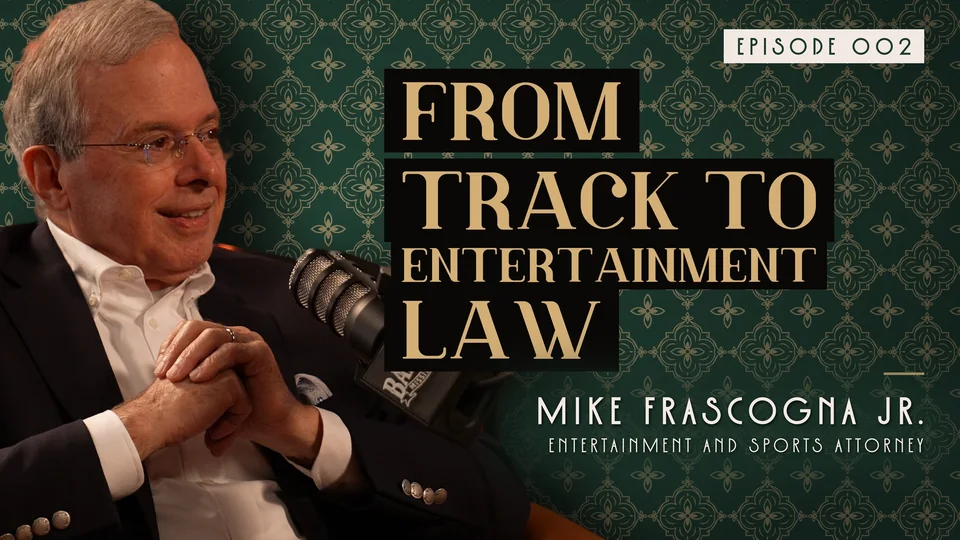
Mike Frascogna Jr. ran track at Mississippi State, booked James Brown as social chairman, and founded Frasco Productions before practicing entertainment and sports law in Jackson. He tells how a letter from his track coach set his path, and the T.A.M.I. Show story of the night the Rolling Stones had to follow James Brown.
Full transcript
0:00Adam Kilgore: Welcome to Barred in Mississippi, war stories for Mississippi lawyers. I'm your host, Adam Kilgore. Here today, I'm glad to have Mike Frascogna Jr. I think they call you internally M2 because you have an M3 in your sign. They do. They do. So glad to be with you. What a lovely place. Thank you for hosting our visit today here in your studio. It's a wonderful place.
Mike Frascogna Jr.: Well good to have you here, Adam, as always.
0:30Adam Kilgore: Well, I want to start interviewing you in a unique spot, and I think this term will resonate with you, the starter's block, as in your track experience. There's so many different directions we go in our conversation, and I may well go every one of them, but I want to start with your experience of track. And part of what I want you to speak to, speak to whatever you want to about that, but I want to think about it and kind of use it as the backdrop, the formative time for you, the solitude of running, and that work. I assume there were times you were out on that track all by yourself doing that kind of work, and later as a lawyer doing that, and then you built things. So tell us what track has meant to you. What comes to mind when I ask you that?
Mike Frascogna Jr.: Track is really the linchpin of how I stumble into entertainment and sports law. So I believe it was March of my senior year in high school at Jackson St. Joseph when it was downtown, right in the middle of Jackson. And my father, who was from the Bronx, New York, and who had attended LSU on the GI Bill, his first job was in Jackson, so that's how our family ended up in Jackson. He said, son, have you decided where you're going to college? This is March of my senior year. I said, yeah, Dad, I think I'm going to go to Ole Miss. And I said, okay, fine. What are you going to study? I said, well, I think I'll study history. He said, okay. He said, what are you going to do when you finish college? I said, well, I'd like to coach football and track and teach history in high school. He said, that's really a bad idea. What you're going to do is you're going to college, you're going to study business, major in accounting, and then you go into law school. And being 17 years old at the time, I simply said, yes, sir. So I'm scheduled to go to Ole Miss, going to live in Kincannon Dormitory with a good friend of mine from St. Joe, Raymond Bracada. So in June, I get a call from Raymond. He said, I got bad news. My sister is married now. She lives in Oxford. My dad said, I had to live with her the first year. He doesn't want me living in a dormitory with a bunch of freshmen because I'll just get in trouble. He said, you need to find a new roommate. It was the next day I got a letter from Coach Jerry Simmons, the track coach at Mississippi State, that said, we'd like for you to come up here and run track for us. So out of the blue, I get this letter. I'm without a roommate at Ole Miss, and I decided I'm going to state, and I'm going to run track. So that's what I do. Fast forward two years. Come home, Christmas, tell my dad, dad, I just don't like running track. It's not a lot of fun. It's hard, and that doesn't seem to be a lot of interest. It's not like we have 5,000 people packing a stadium to see us run, and we're kind of on our own in many ways. And he said, well, son, so what are you saying? You're going to quit? I said, well, no, no, I'm not going to quit. I'm just going to reallocate my time and do other things. He said, okay, well, how are you going to pay for college?
4:26Adam Kilgore: And I was
Mike Frascogna Jr.: stunned. I looked at him, and I said, well, I thought at this point you would pick it up from here. And he looked at me and said, why would you think that, son? And so we had a long discussion. He offered several alternatives. He said, get you a job in the landscaping department at State, or you can work in the cafeteria and bus tables, or you can work in the student laundry, or you can do several things. But you really need to get a job to pick up that slack financially and also from a time standpoint. I said, well, Dad, I don't want to do those things. And then he asked me a question that I answered so incorrectly at the time that I didn't realize. He said, well, son, what are you going to do with that free time? Because you've told me how much effort you put into track. What are you going to do? I said, well, Dad, I think I'll probably spend more time at the fraternity house. Now, keep in mind, my dad's from the Bronx. He didn't know anything about SEC, rivalries, fraternities, that whole culture and lifestyle. And he looked at me with a profound look of disgust and said, well, I'll tell you what I'm going to do for you. I'm going to spot you one semester. And then after that, you're on your own. You figure it out. So what I figured out was I wanted to be a social chairman of my fraternity. And I had been dabbling in that up to that point. And I had collected probably the best collection of band cards, contacts. And instead of just giving away the information free to fraternities and sororities, social chairmen, they'd call and say, hey, do you know of a good band we could get for such and such event? I said, I'm going to start an agency and I'm going to get 20% of these engagements. Typed up some contracts, figured it out, started Frasco Productions, started booking bands at Mississippi State. So fast forward to three, four years later, after undergraduate and graduate school, I had developed, along with my brother Greg, probably the largest independent booking agency in the South. We were doing summer tours for the main agencies in New York and California. And we were booking fraternities and sororities from Texas to North Carolina and really, really making a lot of contacts. And what year would this be, ballpark? Oh, this would have been starting probably in 66, 1966.
7:38Adam Kilgore: And I want to frame this up a little bit. I know it's a commonly told story of people's experience with music when Elvis showed up, when the Beatles showed up. There's something, what was that moment for you? Did you have that moment where you saw Elvis or saw the Beatles and it resonated for you and you got this music thing going or is it more of a transactional, being in position, love kind of thing?
Mike Frascogna Jr.: Oh, I enjoyed it. I enjoyed it. And my senior year, I was appointed social chairman for the university. So I was in charge of bringing in the major acts for the school, throughout the school. That particular year, this would have been 1967. So during that time, my counterpart at Ole Miss was Haley Barber, by the way. And so we booked a lot of the same acts to get better pricing for the schools. But we had, oh, the Loving Spoonful, Dionne Warwick, the American Breed, Bobby Gentry, the Fifth Dimension, James Brown, Spencer Davis Group. We just had at state just a number of concerts where I got to interact with these high-level artists and their agencies in New York and in L.A. And that's why we ended up with a lot of the summer touring business. So when all that was over and done with, off to law school, still booking bands to make a living. But when I finished law school and started practicing law, there was this assumption out there that I was an entertainment lawyer. Well, I was just a lawyer that happened to have booked bands for a number of years and had developed contacts in the music industry. And that's sort of how the entertainment practice started is from that letter from Coach Jerry Simmons back in 1964.
9:49Adam Kilgore: See, I knew this was part of the story, but I had no idea me asking that question would take us where we've gone. Let's step back for a second. I don't want to gloss over your interpersonal skills, what you saw at that moment. You were doing what made sense, natural, you know, have the resources available to you, do it. But somewhere along the way, very early on, you built a rapport with people in the music industry, the acts, and you're a student. I mean, you know, we're taking you back to those early days. What were those conversations like? Was it one lucky moment? Did you cultivate some skills there that you still use today? How does that fit?
Mike Frascogna Jr.: Well, I was probably cultivating skills and never had any idea what I was doing from that standpoint. That's kind of deep for a college kid to be picking up on that. But I enjoyed it. I had a necessity, which really triggered all of it, but I enjoyed it. I saw some correlation between courses I was taking with how it impacted business. Enjoyed immensely business law classes and felt like, well, I sort of like this. This is something I understand. It's not hard like math that I labored with my entire life, but the law just seemed logical. It seemed real. And then I met some very interesting people doing this. I would compare entertainment law as much like practicing domestic law, high emotional situations. Entertainers just live in a real emotional world, Fragile egos dependent on the adulation of crowds and whether or not people react to their creativity in a positive way.
12:02Adam Kilgore: And it can disappear in a second.
Mike Frascogna Jr.: Very ephemeral. Here today, gone tomorrow. A very up and down business. But one of the most important encounters that I had at Mississippi State as social chairman was working with James Brown. And to this day, I still believe he is the most dynamic, single, solo male entertainment ever to have lived. Prince, Michael Jackson, all got everything that they got from an appearance, a dance situation, a presentation situation from James Brown. And I
12:55Adam Kilgore: recall a story. And you could probably come up with the term better than I can. But there was a. You'd see groups and it was not just all the same genre, five, six, seven on the bill, traveling and doing shows. And sometimes it was like, who's going on last? And I recall a story. The Rolling Stones were like, we, you know, we prefer to go last. We're the big name here. James Brown was on the bill. They went behind him and said, never again. We will not go behind James Brown. You cannot follow that up. I assume that that ties right in with what you're saying about his showmanship and just owning of owning of the moment.
Mike Frascogna Jr.: No one should ever follow James Brown. That that that was artistic suicide. And what you're referring to is the 1964 TAMI show, T-A-M-I, in Santa Monica, California. The TAMI show is an important. It's an extremely important event in entertainment history for a number of reasons. First of all, it was the first concert movie ever filmed. There had never been a movie, a concert movie like today. We can watch Woodstock. We can watch a number of events. Taylor Swift. I mean, it's no big deal. Well, that was the first one. What also made it very intriguing is that this was the first time America saw a lineup of artists that crossed genres. So you had, for example, the Rolling Stones, who were on their first U.S. tour. They were coupled up with someone like a James Brown or the Supremes or Chuck Berry. I mean, you had this this this you had the Beach Boys. You had Jan and Dean, Leslie Gore. This just just a mixture of genres that America had never seen before.
15:19Adam Kilgore: At a time that America is not at its most stable in race relations and other things, too. And a concert bill is being made that would bring multiple folks together.
Mike Frascogna Jr.: Well, this was highly controversial in some quarters. But from an entertainment standpoint, it was exposing young Americans, teenage Americans, to this different culture that unless you went into black nightclubs on the circuit, the Chitlin circuit, you would not see these acts. They did not play concerts where they were primarily exposed to white audiences. Now, set aside the fact that in the Deep South, in the fraternities and sororities, that's all they booked were the black acts. I mean, it was Otis Redding. And I mean, you just go down that cast of just so many good acts. But generally speaking, America as a whole was not exposed to that. So the story goes that in the rehearsal, James Brown was told that he would be the second to last and the Rolling Stones would close the show. Well, he came in since, and he sent his road manager to the producer of the Tammy show, this movie that's being filmed, and said, Nobody follows Mr. Brown. You need to put the Rolling Stones ahead of him. The producer, thinking of marketing of the movie and the popularity of the Beatles at that time, held to his guns and said, No, we're going to go with the Rolling Stones because he felt like this was going to propel the movie because most of America, white America was familiar with the Beatles and the Rolling Stones, not with James Brown.
17:26Adam Kilgore: Fascinating. And then we, of course, had a time period where they were writing songs for each other. Not necessarily those two bands, but white acts were writing for black acts and vice versa, and the cross-pollination, and just an amazing time.
Mike Frascogna Jr.: Well that started with the British invasion. I mean, the British acts really started that in a bigger way. It was taking place, but in a bigger way. So, James Brown goes out. He does his performance. The Smithsonian has film of it saying the greatest performance ever rendered by a solo male performer. It took almost an hour to calm the crowd down in order to get the Rolling Stones on stage because they had gone back to their dressing room scared to death and begging the producer, We do not want to go on. So, it took several of the black performers to go down there, calm them down, and say, You can do this thing. Come on up. And if you look at the Tammy show, which you can get on YouTube, Mick Jagger renders the best performance he can under the conditions, And he looks so awkward, trying to mimic, in some ways, James Brown's move. It ends. They go to the dressing room, just demolished. James Brown now finds out for the first time that it wasn't the Rolling Stones that wanted to go on last. They had requested not to go on last because they were aware of James Brown's reputation. But the producer made them. James Brown finds this out after the fact. Goes down to their dressing room. Says, look, guys, when are y'all leaving the States? They tell him, you know, next Wednesday, whatever. He said, I'll be at the Apollo in New York. Y'all leaving from New York? Yes. Be my guest. Come see me at the Apollo. And so, on that night, on the eve of their departure, the Apollo Theater, 99% all black audience, because that was the cathedral for black entertainers at that time. And there were five guys sitting in the front row, five white guys, five Brits. It was the Rolling Stones.
20:25Adam Kilgore: I love the nugget we just came across. I threw out a quote I knew, barely, and we just got all that. Wonderful. Thank you for framing that up. It's beautiful.
Mike Frascogna Jr.: It has a better ending. Fast forward to the recent movie, Get On Up. It was the biop of James Brown. It starts off with that episode that Tammy showed with Brown coming off stage and uttering something to the Brits who were just beside themselves. That movie was partially produced by James Brown, by Mick Jagger, and financed by Mick Jagger. They became very close friends. And filmed in Mississippi. And filmed in Mississippi.
21:13Adam Kilgore: Wonderful. Yeah. And, you know, saw the transformation in Fondren during that time and did a wonderful job there. So, you're in law school. Why did you go to law school? Because my
Mike Frascogna Jr.: dad said I was.
21:25Adam Kilgore: Okay. So, that's a pretty powerful thing. What did your father do? He was a
Mike Frascogna Jr.: geologist. He was the only one in a large Italian family from the Bronx to ever go to college. He went to LSU, as I said earlier, on the GI Bill after World War II. His New York unit was sent to Camp Shelby to train for the Normandy invasion. So, he was at Normandy, I think he arrived there day two. He was an Army engineer, engineering corps. Spent six to eight months in the various battles across Europe. So, when he came back, he had met my mom previously. They got married. He went to Baton Rouge to go to LSU. I was born in Baton Rouge at LSU, in Baton Rouge. And his first job was with Pan Am Oil Company here in Jackson. His office was in the Standard Life building. So, he was a geologist by trade. Worked with, he ended up becoming an independent. Worked with several attorneys, oil and gas issues. And I think he developed a fondness for the legal profession. And encouraged to me to go on to law school. Not necessarily to be an oil and gas lawyer, but to go to law school. He thought that would be a good future. And he was very high on education for all of us. I have three younger brothers. And he pounded that into us. Education, education, education. And as I look back on it, he was the anomaly in his family. He was the only one with a college education. And in retrospect, looking at the accomplishments in his family, he had ascended to a much higher standard lifestyle, however you want to judge it, than his brothers and sisters.
23:44Adam Kilgore: I am a bit surprised at where we've gone from the standpoint. This will not be lost on you, but it is worth saying to the viewers. What you just described in your path and the template being set by your father mirrors Marty's experience. In preparation for us visiting today, I've known you since 1997. You know we've known each other a long time. I'm telling you when. I decided to kind of go a different route. And I went and been listening to Marty Frascogna on an interview he had. And he's telling his story. The two of you mirror each other so much. You know, you as the fathers, you know, you need academics is important in his journey. And even though he grew up in this environment, he very much went the same path you did. Booking bands when he was in school. And correct me where I'm wrong, but it's an amazing mirror image there. Speak to that.
Mike Frascogna Jr.: Well, Marty's got a far better background than I have in that we had a number of clients that created opportunities for Marty to do more than just book bands. He ran North Terminal Recording Studio, which is a studio was it's no longer here in Jackson that was owned by the Williams brothers. There were a number of Grammy records come out of that place. Oh, brother. Where art thou? Two of the cuts were recorded there. Stevie Wonder recorded there. The Williams brothers recorded all of their albums there. So he he was he was involved in that recording in a deep way. And he also acted as a tour manager for a couple of groups where he literally had to go on the road. What comes to mind is a tour in Sweden where he had to deal with all the issues of not only touring, but international touring. So he he he developed a an intense background far superior to what I had as booking bands as a college kid. He was he was deeply involved, which has served him well as he has forged ahead in his entertainment law experience, representing a lot of high level, really famous people and being involved in some very large deals. So were you
26:21Adam Kilgore: a music lover, also a collector of albums and really invest in that? Or was this more of a social transactional opportunity for you?
Mike Frascogna Jr.: A little of both. I mean, I was no different than most college kids back in the 60s. I collected albums when I was in middle school. I had a band. I played guitar. And to this day, when I say I play guitar, it's the same four chords that I played back in middle school. I didn't advance beyond that. But you can cram most every song into those four chords. So I guess, yes, I had a liking, but nothing strange. I mean, nothing that
27:01Adam Kilgore: nothing extreme that led you to believe you were going to be in this world later. OK, so we're in law school and you get out of law school and you've had this assumption that you were mentioning earlier. He must be an entertainment lawyer because he does this. And you did describe how things morph. What was your law practice like at the time you were growing this? What work were you doing? Were you solo or are you with other people?
Mike Frascogna Jr.: For the first, I believe, two years, I was solo. And I was like every solo practitioner. I'll do what I have to do. But I had more people coming to me on the entertainment side because of the assumption that this guy knows a lot about entertainment law. And quite frankly, there wasn't the body of entertainment law existing like it exists today. So knowing the business was probably 80 percent of entertainment law, just knowing how everything worked. Writers, publishers, recording agreements. I mean, all that stuff, if you're in the business, you had to know it. But I remember my first P.I. case. I got it settled and was overwhelmed at the fee. And I took it on my first contingency case. Ended up doing a lot of what I would call entertainment law corollary work, trademarks, copyrights, that sort of thing. Did general litigation, went into court and just did what I had to do to develop law practice. One of
28:50Adam Kilgore: the words that comes to mind for me is composure. You are, in my experience, composed in almost every setting, composed, relaxed, approachable, know how to lay back and let the conversation happen, know how to jump in. I assume that's a skill you developed as you went, but did you have that from the get-go? Were you a composed young lawyer, even though you were learning as you went?
Mike Frascogna Jr.: Absolutely not. I was like every young lawyer. You learn as you go. I was fortunate in that my father, who, as I said, was an independent geologist, gave me some oil and gas work, oil and gas division orders, that sort of thing, going out and negotiating leases. So I think if I had any unique advantage is that I was doing what I would consider some high-end work for my dad, dealing with very high-end lawyers in the state. I was dealing with entertainers who had those temperamental personalities and learning how to cope with that and deal with that. And then I was like most young lawyers, whether with a big firm or on their own, just scrapping and scraping to learn and being scared to death when you did something for the first time to overcome the fear. And say, well, you know, now that I've done it, that wasn't as bad as I thought it would be. But I think all young lawyers go through that same experience in one way or another.
30:37Adam Kilgore: When did you become a study of people? In other words, you, great at communication, we'll talk about negotiation and all the different things that you do. Were you always a student of people and an observer? Or what form did that take for you to develop those skills?
Mike Frascogna Jr.: I think just being thrust into a situation where I was dealing with so many different types of people. Having to go and explain to seven musicians, artists, why they should sign a contract and having to explain every provision of that contract. And entertainment contracts are complex. So to say I had to dumb it down would be that's what a lawyer would say. But a lawyer who's trying to explain it to his clients has to get down on that level because if the client doesn't understand it, it doesn't matter if the lawyer understands it. The client's got to understand it. And I think that helped me. One of the big factors that I'm so grateful for to this day is that our law firm at one time probably represented all the major black gospel quartets in America. And interacting with so many black quartets shaped me because that is a different subset of people that you've got to communicate with in a different way. And you've got to become involved in that culture to understand their goals and what they're trying to achieve. And the story I like to tell about that is I'm in my first year of practice, maybe my first six months, and my first office was at the quarter on the second floor above Poets Restaurant. And I had a maybe a four-room office at a part-time secretary. So on Lakeland Drive at the time here in Jackson. And so one afternoon, my part-time secretary buzzed me and said, Mr. Frascogna, you have a client here to see you. And I said, well, does he have an appointment? And she sort of laughed and said, no, he doesn't, but you don't have any appointments. It was true. I said, well, send him in and I'll meet with him. So in comes Pop Leon Williams from Macomb. And Pop is the dad of the famous Williams Brothers Quartet. All his boys and nephews were in this quartet. And he sits down and he says, well, Mr. Frascogna, I hear you're an entertainment lawyer, and I didn't disabuse him of that fact. I said, well, yes, sir. I do a lot of work in that area. And he said, well, my boys have been offered a contract by this record company in New York, and we need somebody to look at this contract. I said, well, I'll be happy to do that. I've seen several of these contracts. And so we talked, and he told me more and more about his group and about his sons, Melvin and Doug and Henry Green, who I think was a nephew of his. So we talked 30, 45 minutes, and he said, well
34:41Adam Kilgore: here's what I'm
Mike Frascogna Jr.: going to do. I'm going to bring my boys up here to meet you, and we'll talk some more. I said, well, that'll be fine. So he stands up, and he leans over the desk, and he looks me straight in the eye. To this day, I still see the eyes. I said, Mr. Frascogna, let me ask you something. Will you take care of my boys? I said, well, yes, sir. I mean, I'm going to make sure they get a fair shake on this contract. And he said, no. Are you going to take care of them? And I could tell at that point he was communicating something more than the contract. And I looked at him, and I said, yes, sir, I will. And he extends his hand across the table, and I remember shaking that hand. I found out later, he was a bricklayer by trade, and the handshake was firm. It was like a vice. And again, it was occurring
35:54Adam Kilgore: to me, this
Mike Frascogna Jr.: guy's communicating to me in a way I didn't expect. About three weeks later, he shows up, and he's got Doug, Henry, Melvin with him. They all come in, he introduces me, and before I could say a word other than a salutation to each of them, he turns to them, and he says, boys, Mr. Frascogna is now your lawyer. You do what he says, and he's promised me that he'll take care of you. Y'all understand? sir. sir. Yes, sir. Mr. Frascogna, what do you need to know? And here we are, 55 years later, I still represent the Williams brothers.
36:51Adam Kilgore: Quick math, you were mid-20s. Right out of Losca. That is something. I assume that puts you into a culture and a community that you may not have known or had much experience with before then. I mean, you're part of a family unit at this point. They're counting on you for more than just the contract terms. It's truly that counseling and that advice component. Is that fair to say?
Mike Frascogna Jr.: Yes. The gospel genre is different. I mean, you know, you've got country. You've got gospel. You've got rock. You've got, you know, hip-hop later comes along. And to really, to be effective, you've got to understand it. You've got to understand the culture. You've got to understand. You just have to understand it, which is true of any lawyer in any field of operation. It doesn't matter. That is just entertainment. But what happened on that day, and I had no clue, is when I committed to Pop Williams to take care of his boys, that resonated throughout the gospel industry because they were very well thought of. They were very progressive and traditional, all in the same way. And now I have gospel groups coming to me. And the next big one was the Canton Spirituals. Harvey Watkins Sr. almost a replay of the same episode with Pop Williams, he brings the Canton Spirituals to me. And I remember it was the same thing. I mean, these were gospel groups that had been around, that they were traditional powerhouses in the black community. They had, for lack of a better term, political clout. They interacted with all the ministers of the black churches. It took me into black churches. I could not believe going down, I think it's Paul Morton, Reverend Morton in New Orleans and attending a service down there that the Williams Brothers just performed as a gift to Reverend Morton. I mean, you're talking about 3,000, 4,000 people. And you could see the power in the black community, in those churches, in the Williams Brothers, in other popular black quartets. They were part of that. I had no earthly idea that existed. But when I see Doug and Melvin Henry is unfortunately deceased, we laugh and say, we grew up together.
39:53Adam Kilgore: Sure did. Did you ever get any feedback from them or any of your clients as to, but I think I want to stay specific to gospel because I think it's got its own unique components. Did you ever get feedback on why they trusted you, what you said, what you did, beyond the real handshake and the I will take care of them? How did you build that trust? Did you ever get that feedback? I would like to
Mike Frascogna Jr.: think over the years my actions earned that trust, but initially they trusted their dad. That's who they trusted. If our dad says, he's the lawyer, he's the lawyer.
40:39Adam Kilgore: I'm not sure there's a more powerful example of word of mouth business that can be built by virtue of taking care of one person or one set of clients the right way. And that that just trickled down.
Mike Frascogna Jr.: I didn't go looking for it. It came to me in a haphazard way, or maybe it wasn't haphazard.
41:03Adam Kilgore: I was visiting with your son, Mike, earlier, and it is you're echoing some of the things I was expressing to him that it looks like we had a plan. If you put it down on paper, it's like then this, then this, then this. And it sounds like to me, at least at the beginning, it was this is what's available to me, what's around me in my environment. These are things I'm already good at. We'll go with this and let things grow from there.
Mike Frascogna Jr.: To some extent. So while I'm handling the legal work for the Williams brothers, I'm also representing David and the Giants, the Royal American Showman, all these John Fred and the Playboys. I mean, so much of what was going on with the booking agency that I started that my brother Greg ended up taking on was still in force, and that work was coming back to me. We eventually sold the booking agency years later to one of the guys in a band that we booked. And Frasco Entertainment is still in existence. And Alan Davis, the gentleman who bought it, is still booking bands to this day.
42:21Adam Kilgore: So let's go back to law school, because I want to make sure we don't skip some important things. You go to what was then Jackson School of Law. Was it accredited at that point? Do you recall?
Mike Frascogna Jr.: Well, I guess you have to determine what kind of accreditation with the colleges and universities, law schools of America, or with the Mississippi Bar. I mean, you could sit for the bar exam, having finished Jackson School of Law. And I think statutorily, at that time, you could study under a lawyer for some length of time and qualify. But you had to sit for the bar and pass the bar, while the Ole Miss graduates didn't have to take the bar.
43:14Adam Kilgore: Diploma privilege is the phrase. That was the diploma privilege.
Mike Frascogna Jr.: And as Jackson School of Law, it
43:20Adam Kilgore: had been around
Mike Frascogna Jr.: for, I don't even want to venture, I want to say 30s maybe. As it was putting more and more graduates out there, many of them were starting to occupy legislative seats. And that's when the tide started turning, is when the Jackson School of Law essentially had more legislators that brought up bills that say, we need to do away with this diploma privilege. I did not
43:51Adam Kilgore: appreciate that that level of success from the law school was happening that soon. Interesting. So during the law school experience, I assume you had a class, a moment, a mentor, a professor. What sticks out from that time period for you?
Mike Frascogna Jr.: Actually, there were many of them because they were all practicing attorneys or active judges. And as far as receiving a practical education in the law, you got it. And you got it in spades because most of these folks, they didn't have time to mess around. They were practicing law. All the classes were at night. I think they started like at 6 o'clock and went to 8.39. It was all business. And it was no coddling. And I guess there's one scene that I do remember that stands out. Curtis Coker taught torts. Well, there's a firm here in town, Daniel Coker, Horton. Well, every one of those named partners at one time, I had as a professor. But Curtis Coker sticks out. Curtis, when he got out of college, as the story goes, I can't confirm it, but I've heard this many times, so I assume it's true, was a welder. And then he went into the military service, probably World War II, drafted, and I want to say he was a pilot. And then when he came back, he went to law school. And he turned into a very esteemed attorney. Daniel Coker was an insurance defense firm, and I assume still to this day they practice in that area. Well, he taught torts. So I remember the first couple of meetings were kind of rocky in that he believed in the old Socratic method. Smith v. Smith, Mr. Kilgore, would you please stand and tell me all about that case? And you were to then give the facts of the case, give the question of law, give the ruling, and take a position. Do you support this or not? So the first couple of meetings, there was a lot of timid folks, myself included, because Curtis was a big man, burly, eyebrows, brough voice. You just knew he was tough. You just, you could look at the man. And so maybe it was about third class. And the intimidation had reached its height at that point. And there were probably 40 people in the class. So he calls on the first one, I'm sorry, Mr. Kilgore, I'm not prepared. Calls on the second one. Mr. Kilgore, I'm sorry, I'm not prepared. Calls on the third one. Gets the same response. I remember, kind of looked down at his book, closed it, spun around, put the tort book in his case book, in his briefcase, stood up, walked to the door, opened the door very gently, turns back around. And with those big eyebrows, Thursday, every damn one of you better be prepared. Walks out the door and slams it, and you think the glass in the transom is going to break. Go to Thursday. Mr. Kilgore, take Smith B. Smith. Yes, Professor Coker. Never had that problem again. That's what you got at the Jackson School of Law.
48:16Adam Kilgore: Which, and it's important to note for any of our viewers that are not aware of the history there, Jackson School of Law becomes Mississippi College School of Law, which is now Mississippi Christian Law. So we wanted to make sure that we got that history there. I have to share a personal note. But I had a similar experience with a much less stressful outcome. I got called on, and I was not prepared in my, I think it was my second year of law school. And the professor, Jeffrey Jackson, says, you know, Kilgore, I'm going to be ordering some food from you in the drive-thru window someday. What do you say to that? And I said, sir, would you like fries with that? So he didn't leave and slam the door, but I don't think he called on me for a little while. So we had fun there. So that, you know, you've touched on so many important things. And the success of MC Law is so much tied to being in Jackson, being near where all this activity is going on at the Capitol and beyond. And I want to jump back to the work you were doing with recording artists, especially gospel and blues, but it probably extended beyond that. Location, location, location. You are in the epicenter of these things. People are not necessarily thinking about getting entertainment, intellectual property work done in Mississippi. But you're here, you've got connectivity to the community from the various things we've talked about. And it became fertile ground in a place that people might not think seed could take purchase. So tell us about that. Well, at that
Mike Frascogna Jr.: time, trademarks, copyrights were not a thing. Now, they were in New York and L.A. in the true epicenters of the entertainment business. But down here, you didn't hear those terms. So consequently, there wasn't a lot of perceived business. Now, that changed. And we were, I think, part of that change may have been the first real intellectual property law firm in the state. Just because we were thrust into it and we're doing battle with lawyers in New York and L.A. and Chicago and having to face those situations. But it's interesting to note that in the late 50s and 60s, 60s, and maybe the early 70s, Jackson was the epicenter for entertainment in the entire South. What goes on in Jackson today really is not even close to what was going on. And I'm talking about entertainment-wise with the number of nightclubs, the number of live performances, the number of artists who were migrating out of Mississippi to Chicago, to New York, to New Orleans, to Memphis, to Atlanta. And a lot of that has to do, in my opinion, with the unique culture of our state. And I know you can debate, well, you know, every state has a unique culture. Okay, I'll grant that. But Mississippi is unique. It's highly unique. And you take the population of Mississippi, 3 million now, back then, probably could have been under 2 million, and I don't recall. And the number of performers that were coming out of here was not normal. We do it in
52:00Adam Kilgore: everything. We do
Mike Frascogna Jr.: it in sports.
52:04Adam Kilgore: We do it in art.
Mike Frascogna Jr.: We do it in literature. And there are a lot of theories, you know, that can theorize why. But it was very active. It was very vibrant. It was a vibrant place to be. And I can pick and choose certain elements that I can throw out and say, well, this, a lot of it had to do with our black churches and the emphasis they put on music, the choirs. I mean, so many of the entertainers, they came out of the choirs. And even with the great migration, where a lot of black folks in the state migrated to Chicago or to Baltimore, they took that culture with them. And out of that culture, again, you see so many of the entertainers coming out of the black churches. That's one. Jackson State's sonic boom of the sound. I mean, to have good vocalists and good musicians, they have to be well-trained. Go no further than Jackson State. Back then, Jackson State was turning out band directors by the droves. And they took, they taught. And a lot of those guys not only were band directors, but they played in these groups on weekends and further advanced their skills by being on stage and playing in R&B bands. So those two elements, I think, were very important to what was happening in Jackson. And then you have the spillover effect. The irony of ironies to me is in the 60s, during those turbulent years of the 60s, most of the colleges and universities in the South were only booking black bands. They were absorbing that culture when the rest of the country, while they stood up for voting rights and all that, were not immersed in the culture. And so I feel very fortunate to have lived during that time when, to me, the 60s was the best music ever created. And if you want to argue with me on that, go to Renaissance and tell me what music's being played in the background. Right now. Even to this day. I might go with
54:52Adam Kilgore: the 70s because I think it's an inexhaustible resource. Yes, it drifts into it. But they're cousins.
Mike Frascogna Jr.: Yeah you know, I feel blessed to have been just a microscopic part of being able to absorb that culture.
55:14Adam Kilgore: And it's a culture that can be so accepting and uplifting, you know, once you can be a part of it. So, you know, we talked about Papa Williams, if I'm saying his name correct. Thank you. And in that moment, but I have to think there were times where you were visiting some places that you might have been the only person, you know, white person there or very few. So I'm going to ask you again in a different setting. How did you build credibility? By being there. By taking part. By being
Mike Frascogna Jr.: willing to accept and absorb some of that culture. And just showing gratitude for it, acknowledging it, that it is unique, that it is, it's uniquely American. It's more than uniquely Mississippi. It's us.
56:18Adam Kilgore: I had a speaking engagement once, meeting with some people that, well, we'll call it a speaking engagement. It was more of a meeting because of the work that I did. But I was meeting with members of a community. And somebody asked me, like, well, you know, how are you going to do that? And I was very much like, well, number one, if you're not genuine with people, they're going to spot it. And so, you know, make sure you're genuine. Listen, don't act like you know something if you don't. And I said, and the third one was, if in doubt on what you say, what would Bill Clinton do? Because he did such a good job of relating to the African-American community, you know, during his time before presidency and obviously after. And I think that slides into very much into what you're talking about. It's being around, not being afraid to speak up and say, I don't know this. Please explain this to me or helping them see something you see that they don't. You know, it's the give and take. It's a it's a it's a beautiful thing. And it's a privilege is what it is to to to be there with people and minister to their needs in whatever arena it is. In this case, it was entertainment. So let's stay in the entertainment realm. But we're going to we're going to call it sports now, which obviously is important to you from from taking you back to that beginning of track there. Excuse me. And I know I know your sons both played college football. I don't know about Nan and if she did sports. I suspect she did some country. So we've got OK, there we go. And there's a that's a lonely task, even more lonely than the track. You might run into people on the track out in the cross country for twenty six point two. You're flying solo almost exclusively. So tell me how you started to get involved in things related to sports entertainment and, you know, that wonderfully grew into some some some great things for you, too.
Mike Frascogna Jr.: I always enjoyed sports. I don't know why, you know, it just it appealed to me, played baseball, played football, just enjoyed it. I never really got active in basketball for some reason. But I always like track. And I can remember. As a youngster going down to the creek. Clipping off three stalks of bamboo, bringing them back to my backyard, getting some clothespins from my mom and putting together a high jump rig, collecting leaves, putting it under and just practicing high jump just for the fun of it. How old? Eight, seven, eight. That's pretty impressive. Well, I think in your
59:12Adam Kilgore: environment and I wasn't
Mike Frascogna Jr.: impressed. I was just jumping over and but enjoyed it and was always blessed with some speed. Later, find out much, much later in life, talking to my dad, that he was fast, that he came in third place in New York City in the hundred yard dash. And I said, Dad, you never told me that. And he said, I have never important. And then it kind of clicked. Well, I mean, that's that's probably why you just got some natural speed. All right. So high school was football and track. And then off to state. So I always enjoyed it. And I thought it was it was just good. But there was an event that took place in law school that put me on a strange path in athletics. Judy, my wife, was teaching at St. Mary's Elementary School in West Jackson, where both of us had gone to school. We had just moved back from state. I had finished grad school. She had finished because she's two years younger than I am. And she majored in elementary education. And so her first job was at St. Mary's. And I was going to school at night at the Jackson School of Law and booking bands by day to make a living. Judy and I laugh to this day about her compensation back in 1968, $300 a month for teaching, full time teacher. So that was enough to pay the rent, buy the food, and then everything else was on me and booking bands and then going to school at night, studying early in the morning, studying late at night, studying on the weekend. So that first year that she was there, she was assigned the fifth grade. She had maybe 28 kids, 21 boys, seven girls. So she comes home on day three with a really distressed look on her face. And I said, well, what's wrong? Did something happen today? She said, yeah, there was an incident. I really don't want to talk about it. But I had to take a young man to the principal. And I said, well, I just don't know how this is going to work out. I said, well, what's the problem? She said, they're just mad. They're just mad. I said, well, who's mad? The boys. They're all just mad. I said, what are they mad about you? Coming back to school? I mean, what? No, they're mad because they don't have a coach for their fifth and sixth grade football team. And I said, well, surely one of the parents of the boys is going to step up. And that's usually what happens. I said, well, the guy that coaches the seventh and eighth grade team, because St. Mary's went K through eighth grade at the time, he was going to do it, but he just doesn't have time to do both teams. And they're looking for a parent to do it. And no one has stepped up. I said, well, they'll find somebody. A couple days later, same thing. She said, I'm just, they're just disruptive. They just, they won't settle down. They're mad. She said, would you consider? I said, Judy, come on. I'm working in the day. I'm going to school at night. No, no. I mean, all my time is spent studying, studying, studying. She said, I know. I shouldn't even ask you. Next week, I get a call from Father Creighton, the pastor of the parish. He said, Mike, I need a favor from you. And my heart sank. He said, I need for you to come over here and coach this fifth and sixth grade football team. I said, well, Father Creighton, I'd like to. It would be a lot of fun. I would like to do it. But I just, I don't have the time. He said, Mike, a lot of these boys watch you play at St. Joe. That's enough. And I said, Father Creighton, I mean, I'm sinking lower and lower. He said, I need you to do this. I said, okay, I'll do it. I'll do it for one year. He said, okay, that's fair enough. I ended up staying four years. It was riveting. It was thrilling. It was so rewarding. And I have often said, Judy and I learn how to be parents during that four years because I had to deal, like all coaches and teachers, with situations. They're all different. Some are sad. Some are tragic. Some are uplifting. I had to face the death of one of my players. It's just hard to describe. But it was absolutely the best decision I've ever made.
1:05:25Adam Kilgore: Did you, I know you'd played, but did you know what you were, how long did it take before you knew what you were doing coaching?
Mike Frascogna Jr.: Pretty quickly, because I played for the legendary Bill Rayfield. That's St. Joe. And I had kept my playbook. And I immediately became a student of the game. I joined the National Coaches Association, started subscribing to coaches' magazines, going to coaching clinics, and just started absorbing anything and everything. Because remember what I told my dad when he said, what are you going to do when you get out of college? I said, oh, I think I'll coach football
1:06:11Adam Kilgore: and track and teach. So I
Mike Frascogna Jr.: guess subconsciously, I was fulfilling a wish, a need that I had suppressed over my dad's good advice long term, and just thrust myself into it. And there was an article in the local newspaper. I can't even tell you the name of it. I think it was the Southwest Guide, maybe in the third year, second or third year, talking about St. Mary's being undefeated and says, you don't have to go to South Bend
1:06:56Adam Kilgore: to see a Notre Dame team play. On Sunday
Mike Frascogna Jr.: afternoons at St. Mary's over on Claiborne Street, go see the St. Mary's Saints. And that was probably the greatest compliment that I could have received as a youth coach at that time.
1:07:22Adam Kilgore: Do you recall your record, how you did those four seasons?
Mike Frascogna Jr.: I don't record, I don't remember specifically, but
1:07:31Adam Kilgore: my two sons
Mike Frascogna Jr.: totaled it up, went back, and gave me some sort of plaque. I think it was like 894 or something like that, 900%.
1:07:46Adam Kilgore: That's pretty strong. How many plays can you run with a fourth and fifth grade team? I mean, I'd say 12? You'd be surprised. Okay.
Mike Frascogna Jr.: You'd be surprised. It's all how you teach it. And I had
1:07:59Adam Kilgore: such a good experience. I said
Mike Frascogna Jr.: I'm going to make sure that my two boys have this kind of experience. So I ended up coaching Mike, third, fourth, fifth, sixth, seventh, and eighth. I was the middle school coach at JA. Okay. And then Marty in third, fourth, fifth, and sixth. So when the dust settled, I had 14 years of voluntary youth football, which I wouldn't trade for a billion dollars.
1:08:36Adam Kilgore: So many things you're managing there in interaction with parents, which I would hope was better than it can be now. But you still have those same dynamics there. Kid may not have what they need. You're trying to get the, you know, just so, I mean, that's, you've already said how valuable it was.
Mike Frascogna Jr.: Yeah. It's hard to describe, and only teachers and coaches can understand what I'm saying. You just have to be in that trench and have that responsibility. And you develop such a feeling for your players, and that's just normal, or for your students, if you're a teacher. And their problems become your problems. And if they can't find a solution, you want to find a solution.
1:09:28Adam Kilgore: So you, you, you've already mentioned her. You, you picked up a teammate that's been pretty important in Judy, and I'm so glad that she's come up. Tell us about the role beyond what you just said, the partnership that that has been. And of course, at some point, we're going to get to these three wonderful kids that y'all have had together. But tell me about Judy. Judy and I have been
Mike Frascogna Jr.: married 55 years. We lived across the street from one another. We both went to St. Mary's. She was two years younger than I was. We both went to St. Joe. When it was downtown, I went to State. She went to the W. I was trained as an educator and taught for four years. And when our first son, Mike, came along, called her back and said, okay, we both know what you need to be doing from here on out. And she was a stay-at-home mom. That's what she wanted to be. That's, that was her purpose. And I did not disagree with that one iota. And my purpose was to go out, make the money, and we formed that partnership.
1:10:59Adam Kilgore: What role, and those are all important roles, but specific to you, is she the person that, like, if you're not feeling as confident, she's going to grab you and get you thinking straight? Or what kind of role has she served in, as far as the career success goes? Pragmatic critic. Total honesty. Not afraid. And I assume that still exists today. Still exists. That's a pre-key component. Yes, it is. Invaluable. We'll use that word again.
Mike Frascogna Jr.: Yeah, because with success, and now, most of the lawyers out there that might hear this, I mean, they've had success, will have success, are going to have success. And you've got to balance that.
1:11:49Adam Kilgore: What, last thing on Judy, what does, at least for now, what does she bring, you know, a lot of times, a great partnership, reflect each other, also can deflect. So, what is the thing that she's good at that helps fill the gap that maybe you're not as strong at? Or it's like, no, she's the expert on that. We have her in that role. Family dynamic, anything.
Mike Frascogna Jr.: She does the plumbing repair and the electrical repair, and I don't know anything about those things. I think one of the key components, you know, looking back, it's easy to look back, is that there was dinner on the table every night. And the kids and I were expected to be there. And so, we never went more than 24 hours, relatively speaking, without a family dynamic. And she understood the importance of that and maintained that. You know, we will get together. How did it go today, Mike? How did it go today, Mark? Tell me what you did, Dan. What you learning in school? What you interested in? 30 minutes? 40 minutes? It was there. It was almost like an oasis. Didn't really matter what was going on, what pressures I had, or what problems she had. So, you know, she filled that role. And then we sort of specialize. She knows what I'm good at, gives me a free hand. I know what she's good at, and I don't question it.
1:13:45Adam Kilgore: Okay, so as you go forward, you obviously have kids, and you're three for three on kids, my friend. I congratulate you. Well, thank you. Each impressive in their own right. You know, it sounds like you, just from what I picked up on in conversation and some other things, you had a pretty similar approach with your kids as your father had with you. Is that a fair statement? Accountability, you're going to do this or you need to do this. How did you handle those kind of things?
Mike Frascogna Jr.: Well, with my dad, and again, it took me years into adulthood to have the experience to look back and understand. And as I look back on my mom and dad's lives, they both came through the Great Depression as children, had to make sacrifices, I'm sure. And they lived through World War II. And I oftentimes thought, how would I have reacted at my dad's age, who was probably 20, 21, an officer, D-Day, serving the length of time he served in some of the fiercest battles in Europe. How would that have affected my life? And so when I look back with dad, there was no gray. It's black. It's white. I mean, there was no equivocating. There was no, well, my lived experience tells me. No, that didn't exist. It was black. It was white. And you will work hard. You will be highly educated. And you will respect everyone. Black and white.
1:15:50Adam Kilgore: Matter of fact, no other choices. That's it. You just go do it. Yeah. It probably made it easier in some sense.
Mike Frascogna Jr.: In some sense, it did, because that's what was expected. And there was no alternative to turn to and rationalize some other position.
1:16:15Adam Kilgore: It's interesting that you have talked about how your coaching experience was so invaluable. And you've already mentioned that it helped you as a parent. You know, my kids are all in their 20s now. I very much feel like a coach, a coach more than ever. I mean, it's, you know, invaluable. In fact, I feel more equipped to help them now than I did when they were five or eight. Although, you know, similar experience, you're saying yes. We tried to give them
Mike Frascogna Jr.: the direction we got, because Judy comes from a large family, larger than my family. I have three brothers. She came from a family of seven siblings. Her dad was General Bittner, was in the military, and he ended up being the commander of the 172nd Airlift Division. He was from Pittsburgh. Just like my dad was from the Bronx, Judy's dad was from Pittsburgh. They both came south, married southern girls. But his background was very similar in that, I mean, think military. Black, white. That's the way it is. You do this.
1:17:36Adam Kilgore: Did you have a similar experience in Catholic school and in your Catholic faith?
Mike Frascogna Jr.: Oh, gosh, yes, yes. With the priests and nuns, we came through when it was mostly priests and nuns who were the instructors. And what was unique about that, and again, I didn't have a clue at the time, they were not from these parts. Most of those nuns that taught in the Catholic schools came from the Midwest. Many of the priests came from Ireland. So we got a more universal view of the world because it was just natural that they had different backgrounds and experiences than us as Mississippians. And in some, well, I think in most ways it was good because we had different thoughts put in our heads or different thoughts to consider, at least. But as far as the black-white aspect of it in that you did this, you didn't do this, that was very much in place.
1:18:53Adam Kilgore: Well, let's shift to sports, back to sports again. Let's go forward a few years. You know, I became, I got to know you near the time you had brought an NFL preseason game, Jets-Eagles, which I want to say is maybe 1998, I'm guessing on that time
Mike Frascogna Jr.: frame. Oh, 95, 96.
1:19:13Adam Kilgore: That was on my radar and then I met you a year or so later. Tell me about that experience. I know there's others in between, but, and you can pick one if you want a different one, but hit us with, you know, that experience. I mean, it's a big deal to bring an NFL team for a preseason game to Jackson and you were able to pull that off.
Mike Frascogna Jr.: Yes, we, yes, that was quite a feat because it took so long to pull it off, but go back a little bit before that. I think we had established an entity called the Mississippi Sports Council. It was a nonprofit. As a matter of fact, it was two heads. It had a nonprofit and a profit side of it. And we, we really started by bringing in Emory Ballard and Mississippi State coaches for camps, for kids. Well, what motivated me to do that? Well, I was coaching and Mike was playing. I wanted him to have the best education he could get beyond what I could give him. So, I had somewhat of a relationship at State because I attended that. So, Emory Ballard was kind enough to come down here. I think maybe two or three times we did these camps. Please tell
1:20:40Adam Kilgore: me he coached some wishbone in the mix of that because being the father of that.
Mike Frascogna Jr.: You know, he, he, he brought his assistants and they, they coach positions. You know, what does a DB do, how you rotate your hips and what is an offensive lineman doing with split? I mean, that kind of stuff. And then, we noticed the shift away from Memorial Stadium. And the shift came, you know, you know, at one time, Jackson and Memorial Stadium was the epicenter of SEC football in the South. It was the only place that, at least that I recall, had double headers. You could say, see State play Auburn in the afternoon and LSU and Ole Miss at night. And it, I mean, it was big time.
1:21:33Adam Kilgore: It still blows my mind. I've heard that before. It just blows my mind. I mean, if you
Mike Frascogna Jr.: were a football aficionado, it was, it was nirvana. I mean, it was.
1:21:43Adam Kilgore: And a nice stadium for its time, I presume
Mike Frascogna Jr.: too. Yes, it was. And then they added on to it and they put in the horseshoe. But then, Ole Miss and State started expanding their stadiums, floating bond issues. And it didn't pay to have State and Ole Miss play the Egg Bowl here. It didn't. They quit coming for monetary reasons. And I get it. I get it. So the sports council said, well, wait a minute. We've got to do something to try to attract them back here. We've got to do something. So we met with both athletic directors and we could tell they weren't coming back. It was just that simple. The economics at far out distance, them bringing games to Jackson. So it sort of made us mad. Now, in the sports council, you had Ole Miss people, State people. So it wasn't just me and a couple others. It was a lot of people involved. So we said, how are we going to get games in Jackson? So we had the bright idea, well, let's one-up the SEC. We'll go to the NFL. We'll bring in exhibition ball games. There had been an exhibition ball game 40 years back, previous, when the NFL was sort of in its infancy, not literally, but in the early days of it. So we started, and our law firm got tasked with, go for it. I think in a year I went through every preseason matchup for two years into the future and heard all the reasons why. Never happened. And a lot of it had to do with the schedules that are just set, and they had the same economic reasons they could do it and make more money in a different location.
1:23:50Adam Kilgore: We're still in four preseason games era, if I recall correctly. Fifth if you're doing the Hall of Fame game. But, I mean, so it's two and two. You've got two road, two home for the team you're dealing with. Best I recall. And so I
Mike Frascogna Jr.: ended up talking to Steve Gutman, who was president of the New York Jets at the time. And in my investigation, nice fellow, nice fellow, very business. All of them, very business-minded. And told him what we were trying to do, and he said, I don't think that'll work. And he gave me his reasons. And so I said, another one that's just not going to work. And about a couple weeks later, I get a call from him. And he said, you know, it might work. And I said, well, what changed? He said, I think, and I may be off on this, but I think the owner of the Jets at that time was Leon Hess. That name.
1:25:01Adam Kilgore: That sounds correct. Yeah, I agree with that. And he said, I
Mike Frascogna Jr.: talked to Mr. Hess about it, and Mr. Hess has got a lot of timber holdings in Mississippi. He's fond of the state. He'd like to help you out. And he said, we got this game with the Eagles scheduled for such and such. And he said, we're going to have to have X dollars. I don't remember the exact amount, but it was in the millions to do it. And I got all excited because this is the first chance we finally got somebody that said, at least consider it. So we went to work, shish kebab together, a number of corporate clients, LDDS, WorldCom being the main client, went on a big marketing spree, pulled every trick we could think of to get the financial base in place. I learned all about NFL game financing, letters of credit, the way it's all put together, concession rights. So our information bank about dealing in big sporting events and the underbelly and what you look for, we learned it. Because we got schooled. Because before they'd signed those contracts, they sent NFL delegations down. They tested the turf. They went in the locker rooms, went up to the press box, checked all the input wiring coming in. I mean, this detailed, detailed review. And then said, we can't sign the contract. Now, keep in mind, this is a game two years away. Because your locker rooms aren't up to standards. And your press box is not up to standards. And here's a list of all the things we would require. That sent me over to the legislature. Had to work my way through committees trying to get allocations and funding to make those repairs. Got involved in the legislative process. And lo and behold, the legislature funded it for those specific repairs to the locker room and to the press box. Contracts get signed. Promotion campaign going. All their needs have been met. And then you pray that it doesn't rain. So it builds up. It builds up. It builds up. Jackson is a walk-up crowd. Fortunately, we sold a lot of tickets that sort of hedged the disaster bet. And had beautiful weather. And ended up with about, I want to say, it was either 54,000 or 58,000. I think it was 58,000 in a stadium that seats approximately 60,000.
1:28:28Adam Kilgore: I was there that day and remember it and being so excited we had an NFL team there. The weird memory that sticks out, the year before the Steelers had lost Super Bowl to the Cowboys and Neil O'Donnell was a quarterback. He threw two interceptions that were indefensible looking at the time. I was saying at the time, and I think history shows that it's right, the receiver ran the wrong route. It wasn't the quarterback making the wrong throw. Nonetheless, I was so surprised Neil O'Donnell comes out as a jet because he signed his free agent contract. And the crowd's booing him like they're Steelers fans. I'm like, why are you booing this guy? It's just an odd little moment. So we had a Super Bowl quarterback playing in Jackson the very next, you know, preseason next year.
Mike Frascogna Jr.: It was a good game as far as exhibition games go. I have two distinct memories. Jackson State's Sonic Boom was the halftime entertainment. And I remember the teams had come out. Well, actually, I have three memories. The National Anthem was performed by the Williams Brothers a cappella. Nice. And I remember several members from both those squads ran over to the Williams Brothers and shook their hands. Because it was so riveting. And then I remember at halftime, several of the members of the squads were standing there in awe of the Sonic Boom because they put on a fabulous show. But the most distinct memory that I have is that three hours before game time, I get a
1:30:23Adam Kilgore: call from the FBI.
Mike Frascogna Jr.: It says, we have a credible bomb threat. We need to get you down here at the stadium. We're getting ready to sweep the stadium. We'll let you know if this game can proceed.
1:30:42Adam Kilgore: That's pretty stressful and not a lot you can do to manage it, I'm guessing. You tell me.
Mike Frascogna Jr.: I mean, the whole outside, they're tailgating. And it's so they sweep the stadium. Takes about an hour. We're maybe. Another hour away from opening the gates. And they said, oh, all clear. I get to my car. I stay in my car. I'm on the phone talking to someone or doing something. And they come out to the car. They said, we just had another credible threat. We're going to have to re-sweep the stadium. We don't know that we can get it done in time. And we go through the whole exercise again. The doors, the gates open five minutes late. That's how close we were to the wire. Not knowing if that game was going to go forward.
1:31:44Adam Kilgore: And NFL is on strict time frames for a number of reasons. Obviously, television is a part of that, too. So, we don't have much wiggle room here.
Mike Frascogna Jr.: No, no. Because all that work over the press box was because big TV network out of New York was taking it back to New York. TV network out of Philadelphia was taking it to Philadelphia. And you had, like, seven or eight radio broadcasts coming out that were going all over the country. I mean, what's his name? Namath was one of the broadcasters.
1:32:26Adam Kilgore: Okay. Joe Namath. I forget
Mike Frascogna Jr.: what network he was on. But that's when I learned the hard way, involuntarily, the importance of the security factors or elements that go into these big events. So, it is with great appreciation when I go to a big event and I'm looking around at these different, you know.
1:32:57Adam Kilgore: You appreciate it at a level most others don't. You know what had gone behind it. So, you said FBI, which may or may not be the perfect segue to the very thing I wanted to make sure we talked about. And I'll back it up this way. One of the favorite classes ever at the law school is counseling and negotiation. Thank you. I was grateful to get to take that class. You've been an adjunct professor for years. Beloved. I'm not going to give away the secret of your class, but there is something you say the first day that if you just pay attention, takes care of it. Just a wonderful experience. In the course of that, and I know you've written books as well, we can't leave here without talking about how you ended up in a hostage negotiation situation. Was that when you met the FBI? Was it the FBI? Is that how you met them or did it come about a different way?
Mike Frascogna Jr.: Well, the situation of the ballgame was many years prior to it. I remember that day. That sticks out in my mind for a number of reasons. I get a call. It's Friday afternoon. I can't remember the month. I want to say it was in the spring, March maybe. It's a Friday. And I see where the weather's really going to be nice. And I don't have a busy schedule. And I think to myself, gee, I can get everything done this morning. Judy and I go to lunch and then we'll have a full afternoon. This is going to be great. So to the office I go, get in, have maybe one meeting, a couple phone calls. Looks great. Maybe around 1030, my receptionist buzzes me and says, Ms. Frascogna, there's so-and-so on the line from the FBI needs to talk to you. And I'm thinking, it's Wayne Farrell, a good friend of mine, playing a joke on me. So I answer, yes, Mr. FBI, what do you need? Thinking it's Wayne or one of my buddies who takes joy in creating that kind of stuff. And the guy's very serious voice, he says, well, Ms. Frascogna, this is so-and-so with the FBI. Are you aware of the hostage situation occurring here in Jackson at the such-and-such hotel? I can't even remember. It's on the interstate coming in. I said, 55. I said, yeah, I've seen it on the local news. And he said, well, the gentleman that is held up here with his son says you're his lawyer. I said, excuse me? Yes, he says you're his lawyer and he wants to talk to you. Would you come down here? And I said, you may have the wrong person here. And he said, oh, no, he's quite emphatic. So I said, well, let me come down there, but I think there's a mistake. So I tell Janice, my secretary, what's going on, and she sort of laughs. And my younger brother, Pat, who happens to be a lawyer in the firm at the time, he said, oh, man, this is exciting. Can I come with you? I said, sure, I think this is all a mistake. And Jim Powell, another lawyer in the firm, says, hey, I want to go, too. So in the car, we pile in and take off. And we're in the IBM building up on the interstates. We're five minutes from the place. Pull up. And I noticed there are several tractor-trailer, the boxcars of the tractor-trailer trucks are embedded between the hotel and Cowboy Maloney's retail business there. And they're SWAT people up on these. Man, no, it's a good
1:37:14Adam Kilgore: time. I have a diabetic, and if I don't eat something, just get a snack out of my car, I'm not going to be okay. Are you okay with five here?
Mike Frascogna Jr.: I'm very okay with five.
1:37:24Adam Kilgore: So you have approached, and you see trailers. Recreate that scene again for us, please.
Mike Frascogna Jr.: So as we approach this hotel where the event is occurring, I notice there are tractor-trailer boxcars between the hotel and the Cowboy Maloney Superstore and their SWAT team snipers on it. And come in the front, and the entire lobby and the upstairs, kind of a balcony situation, have been turned into some sort of headquarters for what's going on. There's some extra equipment they brought in. They had turned off all the utilities in the hotel, had evacuated the hotel. And I went up the stairs to the room where all the big shots were, and there was JPD, hostage negotiator there. The FBI was there, some gentlemen from the FBI, Sheriff's Department, and other law enforcement. Because this had been going on now for five, six days, and there were children involved. And so they explained it to me and said, now, we've got a direct line into the room. We'll go ahead and make contact with the gentleman, and you can talk to me. And I said, will you be on the line or not? He said, we would like to be on the line. I said, well, no, wait a minute. If I'm his lawyer, I don't want you on the line. But I don't think I'm his lawyer.
1:39:21Adam Kilgore: You still don't know this person at this point? No. You have no reason to think, know why he even named you?
Mike Frascogna Jr.: I don't know. I'm going along with it, thinking, well, it's kind of exciting, but this isn't me. They've got the wrong guy. So he gets us connected, and he immediately starts talking fast, and you can tell he's nervous. And the gentleman says, and that's why I think they're trying to kill me. And I said, okay. I said, all right. Now, when was the last time you and I talked? Before today. He said, well, you know, it was at that Czech cashier convention down on the coast two years ago. And so I'm thinking, the Czech cashier convention. And I said, and remind me, what is the name of your company? And as soon as he said it, bingo. I remembered the name of the company, but not the name of the owner. And this is when we had been retained by the Czech cashier's association at that particular time to represent various businesses that wanted our services who were in this association on cease and desist orders from the Mississippi attorney general on their Czech cashier. Cashing operations. So I finally put it together. Oh, and I remembered the guy. Very nice. Nice fellow. Very well-groomed, well-dressed gentleman. And so at least it finally registered with me. The story he told me was this. I picked up my boys. I think there were three. For my visitation with them, he was divorced from his wife and he had, you know, child visitation rights. And he said, but while I had them over the weekend, I found out my wife had an insurance, life insurance policy on me. And she was going to have me killed to get the money. And I'll use his first name. I said, but Willie, how do you know that? Well, so-and-so told me. I said, but how do you know that's true? Well, I believe her. I said, well, that doesn't make it true. Well, my wife's capable of doing this. I said, well, okay, set that aside. She's capable. But you're telling me there's this million-dollar life insurance policy and she's going to have you killed. Yes. I said, well, we got to get to the bottom of that. So I explained how we could do that. I said, I'll send these two lawyers that are here with me enjoying the whole situation, sitting on the sideline. I said, I'm going to send them down to George Dale's office, the insurance commissioner, because life insurance policies have to be registered with the insurance commissioner. And I'll get them to check it, and I'll have the FBI call ahead to make sure we get prompt treatment. Would that satisfy you if there's nothing of record? He said, I don't know. I don't know. But go ahead and do it. Send them down there. Long story short, there's no life insurance policy. George Dale gives us an affidavit to that effect. Bring it back. And I tell the guy, Willie, got an affidavit. We'll send it down to you and slide it under the door. And so somebody from the SWAT team took it down there and did it. Finally got him convinced that there's no life insurance policy. And at that point, he let one or two of the boys out. So when the boys were out, I think there was one more remaining. And the FBI questioned him and verified that he had a lot of weapons in the room and ammunition. So he was armed and considered dangerous. So it goes on, oh, maybe two, three hours back and forth, back and forth, back and forth. And I kept telling him, look, Willie, right now, you haven't committed a serious crime. You need to just come on out, send your son out first, come on out. And we can handle this because, fortunately, Pat, my younger brother, criminal lawyer. Eventually, we got the other son out, and eventually he agreed to come out after more talk. But he had a condition. He said, I'll only come out if you're the one that comes down to the door. And I said, OK. Now, he was not in the main building. He was in a little annex that was outside, kind of off of the main building. So that's why the snipers and the SWAT team, that's what they had a bead on, on that door. So I told the FBI what he said. And they said, well, we can't agree to that. I mean, that's, no, we're not going to put a citizen at risk to do that. I said, well, what's your choice? He said, we're just going to have to storm him in there and take him by force. I said, well, he's armed. That could be tragic. He said, well, we know that. But it could be tragic if you're involved and you get hurt. I said, well, I don't think the guy will do that. And they said, Mr. Prescott, the guy is crazy. Don't you understand? And I said, well, apparently I don't understand. And I said, but I'm willing to do it. They call Washington. That's what they told me. And they got clearance. Said, okay, here's the way it's going to go down. You're going to wear a bulletproof vest. And they started strapping it on me. And it was at that point I thought, oh, hell. Maybe this guy is crazy. And then they put a heavy metal helmet on me. And then they had two SWAT guys who were dressed in battle gear themselves who appeared to me to be seven feet tall with automatic weapons. They're going to escort you down the dark hall outside and position you in front of the door so he can see you through the peepo. There are going to be two other SWAT gentlemen on each side of the door that he can't see. And when that door is open, one of the guys next to you is going to throw you on the ground and lay on top of you. And the two guys on the side of the door are going to knock through the door and get him. And we hope there's no gunfire. So I find myself walking down a dark hall with two SWAT guys, one on my right, one on my left, going outside in the sun, standing in front of a door and see two other SWAT guys on each side. He opens the door. I go to the ground. One of these big guys comes on top of me, weighed a ton. And they captured him.
1:47:33Adam Kilgore: There's a lot there. Did you have any hesitation? Oddly, no. Until they put the
Mike Frascogna Jr.: bulletproof vest on. Then I think at that point, my curiosity and the excitement of the moment turned to being frightened. I think this is going to work out okay. I certainly hope it does. Yeah, it's going to work out. I know it'll work out. On the other hand
1:48:08Adam Kilgore: how do you live
Mike Frascogna Jr.: with yourself if they blast in there and the guy gets killed? Did you
1:48:19Adam Kilgore: feel dishonest or disloyal to your now client that you didn't know until you, you know, established this on the most unique of phone calls? Did you feel any, any, I'm not saying you should have. I'm just asking, did you feel any disloyalty or compromised because you know what's, you know, you know there's the two people inside the door. You know this isn't going to be a big, long conversation. This is a tackle and go.
Mike Frascogna Jr.: It's out of my control. I mean, I think the worst I felt with when I came home that night at dinner when Judy said, and what happened today? I thought we were going to spend the afternoon together and I explained it. My daughter, Dan, says, you know, Sunday night there was this guy that called asking for
1:49:12Adam Kilgore: you and I forgot to
Mike Frascogna Jr.: tell you. And I said, did he leave his number? And he said, he was in some hotel on the interstate.
1:49:26Adam Kilgore: Wow. I, I, you know, I've heard the story before and I'd forgotten some components. I did not, recall the, the connectivity that was there and this person feeling like they're a client and they did become a client for, for, for that purpose. And, and you just stepped right in. Did you, you didn't say anything about building rapport other than trying to figure out who this person was. Did you have to build trust in the phone call or was it kind of already ready made from a. Well, he was, he, he
Mike Frascogna Jr.: didn't want to be in that situation and it had gone too far. And he, he had made some missteps, obviously, and he didn't know how to get out of it. But he, I truly believe he had a fear that there was a contract out on him. So we extracted him, went with him downtown, got him out on bail
1:50:27Adam Kilgore: that night and, or maybe it
Mike Frascogna Jr.: was the next day. He was told you're out. Part of the bail was don't purchase any firearm. the same day he purchased firearm, got re-arrested. the family jumped on board, tried to have him committed, excuse me
1:50:54Adam Kilgore: he got sent to
Mike Frascogna Jr.: whitfield. Back in six months, came to visit our office, wanted us to file lawsuits against JPD, the FBI, Cowboy Maloney, the hotel. after several meetings, we told him, you don't have a case, we can't represent you. He then sued us pro se and filed a bar complaint. Okay. And then when that finally ended, or during the pendency of his pro se lawsuit, he was committed to Whitfield and stayed down there a longer period than six months until he got his medication fixed and
1:51:41Adam Kilgore: the suit was
Mike Frascogna Jr.: ultimately dismissed. And of course that causes all sorts of ripples in one's professional
1:51:50Adam Kilgore: liability rates and
Mike Frascogna Jr.: carrier, but it eventually, it was all resolved and I hope he's doing well. I've had no contact with him since then and I hope he's doing well.
1:52:04Adam Kilgore: Strikes me. You were using the same skills you've always used for every meeting and every interaction. This one just had much higher stakes than most of the rest of them. Is that fair to say? And you just slide into the process and do what makes sense. Next piece of information, next interaction.
Mike Frascogna Jr.: Yeah. Yeah, I get it. That's a fair statement.
1:52:24Adam Kilgore: Okay. Well, powerful stuff. And I know that is just a part of your counseling and negotiation work that you've, that, you know, you've imparted upon students as an adjunct and, you know, obviously a memorable story among many others. I want to shift now to where you are now and where you're going. But the phrase that has come to my mind in thinking about our visit today is the art of staying curious. And you have never not been curious. And so you're continuing to do that. As I understand, you've recently got a degree in something else. Maybe at Ole Miss, tell us, tell us the academic work you've done recently.
Mike Frascogna Jr.: Well, 12 years ago
1:53:13Adam Kilgore: age 68, 12
Mike Frascogna Jr.: years ago, I was just burnt out managing a law firm, which I've done
1:53:24Adam Kilgore: from day one
Mike Frascogna Jr.: and practicing law in general. I mean, the litigation was just kind of repetitive. The transactions were repetitive. And I said, well, I don't want to stop because there is some element of joy. And my two sons were involved in the law firm, and I certainly wasn't going to just abandon them once I got them in. I said, I'm going to go back and do what I've set out to do when I talked to my father and said, I want to teach. I said, I'm just, I already had a master's in history. That's what I did in graduate school when I was at stake. I said, I'm just going to go back and finish up and get a Ph.D. in history. And I did. And it took me seven years. I went through all the academic challenges, the minutia that you've got to put up academically, because that world works entirely differently. And went to Ole Miss, thoroughly enjoyed it. It was a great experience. I met a lot of smart young people and smart young professors and found out that at my age, I was totally different from them in ways of thinking that life experience had taught me or maybe made me cynical. I don't know how you want to view it and was taken back at their view of the world and had the opportunity in classes to express that, which I hope helped them. I know it helped me get it off my chest and say, y'all looking at it wrong. You need to look at it this way, whatever the issue was. But a great experience. And I learned all about FDR and the New Deal, something I didn't know anything about. And the program was in contemporary U.S. history, which is reconstruction to the present. And it was fascinating. I mean, I find history just fascinating anyway. And it doesn't matter history of anything. History of China. I would enjoy that. Just how did we get where we got to?
1:55:51Adam Kilgore: And so was that for the pure intellectual pursuit or did you and do you have plans with that additional degree?
Mike Frascogna Jr.: No plans at all. It was for the pure intellectual, just for that, nothing more. And I had fun with my dissertation. And you're going to see how this comes all the way around. I wrote my dissertation on the Tammy Show of 1964 and all of the implications that that one concert had on culture, U.S. culture in the 60s and what it's brought us to today.
1:56:36Adam Kilgore: I'd like to read that if it's available. And the beautiful thing to share with our audience is, other than knowing we were going to visit today, we did not exchange any information. Me throwing that quote out was just as random as can be. And it wrapped and tied into everything. What a wonderful, you know, way to just, way to wrap it up. And I am going to wrap it up here, Mike. It has been such a pleasure to sit and visit with you today. I want to thank you on behalf of the profession for who you've been and what you continue to do. And there's plenty of tire left on that tread. You keep taking care of yourself. You've earned some downtime. Don't take too long because we could still use you around. And I hope this is not our last visit. I'd like to do another one because I think there's a lot of stuff left to uncover and touch on. But you sharing with us today has been very valuable, and we appreciate it.
Mike Frascogna Jr.: Thank you for those kind words.
1:57:33Adam Kilgore: Okay. Well, that wraps us up for today in Barred in Mississippi. I'm your host, Adam Kilgore. We look forward to seeing you next time.
Barred in Mississippi is for conversation only and is not legal advice. Guests speak for themselves.