Episode 003
Robbie Greenlee
Trial Attorney, Butler Snow
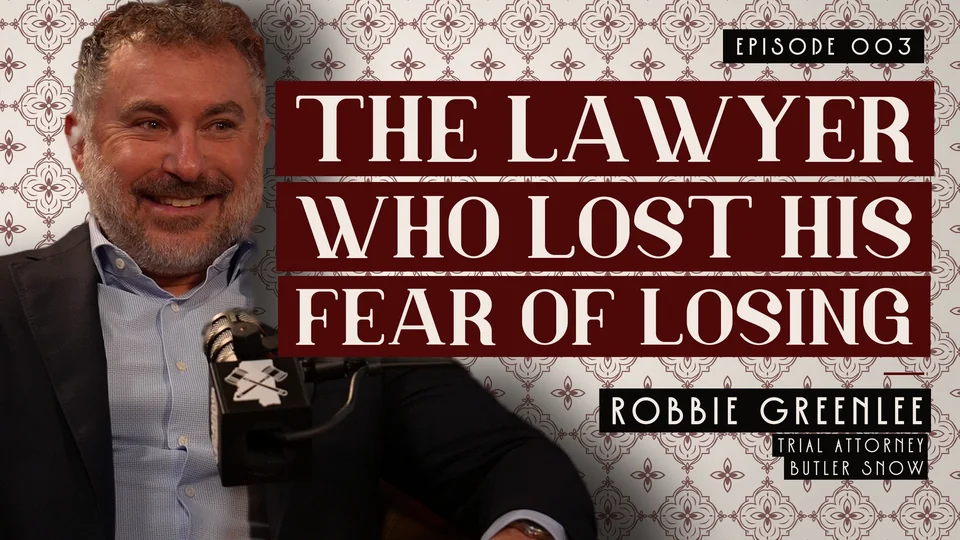
Robbie Greenlee came from Monroe, Louisiana, for law school at MC and never left. He has worked defense and plaintiff’s cases, big firms and solo, and now tries cases for Butler Snow. A firm collapse and a two-pound premature son nearly drove him out of law. Coming back, he says, “I lost my fear of losing.”
Full transcript
Robbie Greenlee: On my side of the courtroom, there were probably 15 defense lawyers. And on the other side, there was one plaintiff's lawyer. And I said, maybe somebody will get scared and flip. And I filed it, and somebody got scared and flipped. On the way home from that deposition, I just decided, I'm done. I'm done with the practice of law. I lost my fear of losing because I felt like I had already kind of been through it. Potter said, mommy, you have 0% evidence that we're the ones who turned that light on.
Mike Frascogna III: Hey, welcome back to Barred in Mississippi, War Stories from Mississippi Lawyers. I'm your host, Mike Frascogna III, and today I've got Robbie Greenlee with me. He's a trial attorney with Butler Snow, but we're going to go way back with Robbie and talk about how he even got to Mississippi because this podcast is, in fact, about Mississippi lawyers, but you're not from here. You're a transplant. So we've got to get you to Mississippi first. Robbie is known, he's been through a lot of different levels of the practice of law here in Mississippi, everywhere from a solo practitioner to the big firms, from defense to plaintiff. Everything in between. He is a well-traveled, well-experienced attorney and is now really known for his ability to put together complex cases like a giant puzzle and take them to trial successfully. A lot of lawyers don't take things all the way to trial. Robbie has the experience and has done quite a bit of it and has been very successful in doing so. Robbie, thank you for being here. I appreciate you making time to do this.
Robbie Greenlee: Thank you very much for having me, Mike.
Mike Frascogna III: So here's the first place we're going to start because we actually have a friendship that goes back some years. And so to illustrate that, I'm going to show you a photo that was taken at my house, I think, three years ago, and we'll show it on the screen, but you can explain to me what's going on here, because this is a family photo of my family: my parents, my brother and sister, their spouses, all the grandkids, at a Christmas party. It is rare that we get to take this picture. I mean, it's like a rare, rare family photo. And then back left corner, second from the left is Robbie's face sticking into our family photo. And the thing is, after this was taken, my mom, who, you know, you would think, as she is known as Juju, Juju would be really pleased that we have this family photo. And it's like, who photobombed it? Her reaction was, hey, look, there's Robbie. He's in the picture. So she was actually happy that all of her nine grandkids and Robbie Greenlee was in the family photo.
Robbie Greenlee: I couldn't help myself. I was the only one not in the photo, and I've been knowing you and your family for so long, I just decided that I was going to be a part of the family.
Mike Frascogna III: And that's the thing, nobody thought anything different. It was like, well yeah, I guess Robbie will be in the picture too. That just seems normal.
Robbie Greenlee: That was fun. That was fun.
Mike Frascogna III: Yeah, that's framed in my parents' house, I believe, so you're immortalized in there somewhere. So that illustrates some of our past together, but yeah, we've run parallel for, I guess, a couple decades now. Let's go back to, like I said, this is a podcast about Mississippi lawyers, but you're from Louisiana. So kind of get me, how'd you get to Mississippi?
Robbie Greenlee: So I'm from Monroe, Louisiana, born and raised, went to college in Monroe, and then ended up here, came here for law school at Mississippi College. That's how I came here.
Mike Frascogna III: Why Mississippi College? Did you consider anything else? Why here?
Robbie Greenlee: I considered other schools in Louisiana, but Mississippi College is closer to Monroe than the Louisiana law schools, and MC had a great reputation amongst Monroe people. There was a lot of Monroe people went to MC, and so it was known to me, and so it just worked out.
Mike Frascogna III: What else is even in Louisiana? I've never even thought about it.
Robbie Greenlee: LSU, Southern, and Tulane.
Mike Frascogna III: Okay, Tulane. I didn't know that LSU had a law school.
Robbie Greenlee: Yes.
Mike Frascogna III: I don't think I realized that. So when you came to MC, did you know anybody here?
Robbie Greenlee: Not a soul.
Mike Frascogna III: Really?
Robbie Greenlee: I didn't know a person here. I was on my own for the first time away from friends and family. And it was a good thing because I buckled down and studied and had a good law school experience doing that.
Mike Frascogna III: Speaking of law school over at MC, again, we're fellow MC Law grads. You were a few years before me. When did you graduate?
Robbie Greenlee: I graduated in 2002.
Mike Frascogna III: Yeah, you were exactly three years ahead of me, and I knew you before I got to law school. What were your expectations of law school, and where did it maybe meet expectations, and where did it fall short? Because I think going in, we all have a sense of what we think it's going to be, and then you experience it.
Robbie Greenlee: I did not know what to expect. I really had very little in the way of expectations. I knew that I wanted to be a lawyer. I wanted to be a lawyer since I can remember the seventh grade watching a show called L.A. Law and seeing that show and thinking, I want to be a lawyer one day. And I've always, so I've never wavered off of that. I didn't always plan for it. I didn't treat college as a precursor to law school. I just assumed that I would go to law school and be a lawyer. Early on, I had thought that I would be a criminal defense lawyer. But I've never done any criminal defense law. But getting into law school, I had no idea what to expect. But during my first semester, I did feel like that the material and the structure of it worked really well for me. I felt like that the subject matters in law school clicked for me better than subject matters in college and even in high school. I felt like I was in the right place.
Mike Frascogna III: What did you major in undergrad?
Robbie Greenlee: Criminal justice.
Mike Frascogna III: Criminal justice. I hadn't even thought about L.A. Law in a long time, but I remember watching that too. And the main thing that I remember about the show, because my dad would watch it and he liked it, but he would always comment there was one lawyer on the show that did not wear a T-shirt undershirt with his button-down shirt. And dad would always point it out like, I can't believe that guy doesn't have an undershirt on his shirt. It's a weird thing to observe, but apparently, you know, it struck a nerve with him. And I always remember that. So once you got to MC, first year, what were your experiences with first year classes? Was it overwhelming? You know, that tough first semester, how'd you handle that?
Robbie Greenlee: First semester was tough because it was a big uncertainty as to how things were going to be graded and how I was going to measure up. And so I studied really hard. And then when I got my grades my first semester, they were really good, better than I had ever made before. And so that was a really big confidence builder for me. It made me feel like I could do this. And so that was a big boost.
Mike Frascogna III: Who were your favorite professors from that first year? Because we probably had a bunch of the same ones about that time.
Robbie Greenlee: Well, your good friend, rest in peace, Lee Hetherington, Judy Johnson were great professors. And then we had a contracts professor named Keith Rowley, who was an adjunct who was really good and was really good at teaching contracts. And contracts was something that ended up being one of the more interesting areas in law school for me. So I would say they come to mind off the top of my head.
Mike Frascogna III: When you went into law school, you said that you thought you would be a criminal defense attorney. And in fact, you haven't done any of that. So did you have any experience with that? Did you clerk and try to get into that area? Or did you rule it out once you got to law school?
Robbie Greenlee: I never ruled it out, but I never exactly pursued it. I essentially took opportunities as they came and I needed to work. That's why I needed to make some money during law school. And so when the first year on campus interviews came out with all the big firms, I was interviewed by all of them because my grades were good and I got rejected by every single one. And then someone in the career services department pointed me to your dad. And so I came over here and interviewed with your dad and ended up clerking with Mike for the rest of my time in law school.
Mike Frascogna III: Yeah, I knew that you had clerked over here, and I'm sure that's how I first met you. But I don't even remember our first interaction. I just remember you being over here. Because that was before I had gone to law school. I wasn't with the firm. What were you even working on at the time?
Robbie Greenlee: It was a lot of civil litigation with Jim Powell and Matt Hetzel. That was the bulk of it. I don't remember a lot of the specific cases, but I do remember that it was civil litigation. And I was doing grunt work, putting pleading folders together. It was a lot of preparation work, helping people get ready for hearings or depositions, but I didn't go to any of those myself. Your uncle Pat was here. He was doing some criminal work, and so I would get some exposure to that through talking to him and having him explain some of his cases to me. But then also dabbling in some of the entertainment work with your dad, with the, remember the big football game that he would put on?
Mike Frascogna III: The backyard brawl.
Robbie Greenlee: The backyard brawl. Yeah. With that. So I was getting exposure into a number of different areas, but not exactly deep into the litigation, but some exposure into a lot of it.
Mike Frascogna III: Okay. I know you were involved a lot in moot court at MC, right?
Robbie Greenlee: I was, yeah. I did moot court, which at the time was only appellate moot court. They now have trial moot court, where you have actual jury trial structure. At the time, it was appellate practice only. And I enjoyed that a lot. I enjoyed getting on my feet. All these things were things that were terrifying to do at first. And fortunately, you had to do it. You had to do at least one round. And so I would do it, and I liked it, and I would get good feedback. And so at those steps of the way, there was enough positive feedback for me and enough good feeling about it to feel like, hey, maybe this is where I belong, and I need to be doing this, and I should continue that.
Mike Frascogna III: Did you take trial practice when you were there?
Robbie Greenlee: I did, under Pat Bennett.
Mike Frascogna III: I had it under Professor Bennett as well. That experience was so different to me than other classes, because like what you said, you could get on your feet. There's a little bit of a performance to it. It wasn't just, I'm just writing. Did that appeal to you?
Robbie Greenlee: It did, but I remember the trial from that trial practice class and how I remember being absolutely terrified. And looking back, I can remember parts about it and just thinking how unprepared I was. I was prepared, but in all the wrong ways. We learned these things, but what I wasn't prepared for is the feeling of what it feels like when you stand up in front of a jury for the first time and you're looking at them and they're looking back. That was the terrifying experience, but we got through it.
Mike Frascogna III: So when you graduated, did you explore leaving the state or did you pretty much have opportunities here that were lined up and you stayed because of that?
Robbie Greenlee: I had a hard time finding a job after law school. A lot of it was because I was from Louisiana and a lot of the feedback that I got was that firms were concerned that you would work there a couple years and then go home. And so, you know, we had talked about potentially staying on with your dad, but ultimately decided it was best for me just to go out and just kind of start making my own way. And I ended up taking a job in Hattiesburg doing medical malpractice defense work with an excellent medical malpractice defense attorney. But the timing wasn't good. It was right at the time of the first wave of tort reform had come through and the work was volatile and it ultimately just was not a good fit. And so after about six months there, I came back to Jackson and went to work with a larger, more regional defense firm, doing mass tort, asbestos work, and sort of riding the asbestos circuit doing depositions is where I went to next.
Mike Frascogna III: Did you experience that and think, I feel like L.A. Law now, or did that leave something to be desired?
Robbie Greenlee: It was a great experience because I was doing a lot of depositions and so I was learning the mechanics and the working with people and finding out ways that worked and what didn't work. I was slowly getting into the idea of that I had to find a way that works for me and getting out of the idea of someone doing it the way someone else told you to do it or the way you saw someone else do it. You can learn from those things, but ultimately I had to find my own way. Made mistakes along the way, angered some witnesses and lawyers along the way, but got good at it. And then the time came where it was, okay, I feel like I've gotten all I'm gonna get out of this. So now I want to do this, or I want to do that, and the structure of the firm was such that we already have people that do those things. And so I kind of hit my limit on growth, in my view, at that particular firm. It was a great firm and a great experience, though.
Mike Frascogna III: Tell me your take on this. You know, you go to law school and you get a lot of new information that's thrown at you, absorb a lot of information. And then you step out into the actual business world to practice law. And there's just a massive gap there between what you are at the end of law school and then actually having to apply it in the real world and apply it well enough that people are willing to give you money for it.
Robbie Greenlee: You know, in law school, when you finish law school, you're essentially on top. And especially if you've had a successful law school career, you come out of it on top and then you enter the law practice and you are at the bottom. And the eye opening part of it is that when you get thrown into it, you know, you're easily dispensable. No one cares, so to speak, what you did, what kind of grades you have, what you did in law school. Nobody's impressed that you went to law school because they all went to law school, too.
Mike Frascogna III: They all went to law school, too.
Robbie Greenlee: Right. They all passed the bar. And there's something to be said, though, to be in a firm where the lawyers that you're working with don't treat you like you're not important, that they recognize you as a person and not just a rookie who doesn't know what you're doing, because you do have things you can offer. Identify people who do things that fit well within your system of beliefs and the way that you want to do things. There's nothing worse than seeing a lawyer stand up in court and give his best impression of his bulldog partner when he's not a bulldog himself. And you don't have to be a bulldog, but you have to be yourself. So you have to be real and not everybody is alike. So, you know, if you're in a place where you feel like everyone is judging you because you're not like them, then you're probably not in the right place. And so, but it's important for everyone to see you for who you are and help build strengths that they see in you because nobody's good at everything.
Mike Frascogna III: Who were some of your early mentors where you had a good experience with them, where they handled it, like you said, the right way instead of it being more like fraternity initiation and hazing, which, you know, that exists too. But where were some of those better experiences along the way?
Robbie Greenlee: You know, your dad was a good mentor to me, even though I didn't come to work here after law school. He was available and we would talk from time to time. And, you know, I remember, whenever I was finishing my career here, him explaining about, you know, your destination and how the ship has to sail with the wind. And sometimes you have to go this way in order to go that way. And you have to find your way that way. And so along the way, there were certainly people who were encouraging and not discouraging. One that stands out is a lawyer, Hunt Cole, who was an older lawyer at Forman Perry. He was an older, very experienced person. Kind of a rigid guy, but one of the things he would always say to me is, learn your craft. He was demanding, but he was demanding in the right ways, because he would always say, learn your craft, figure out what it is you're doing and get as good as you can. Don't just try to get by or turn something in. And so he was very detail oriented. He would redline your briefs and nitpick your briefs. But he would also explain where he was coming from, why he thinks it should be done this way. And so lawyers like that who are willing to take the time to explain to you why what you're doing could be better are the ones that I tended to gravitate to the most. You know, and the Forman Perry environment was a great environment all around, but I worked closely with Hunt. And I tell you, a couple of really good connections that I made there was a man named Mark Ray and another named John Kitchens, John T. Kitchens, who was the former circuit court judge in Rankin County. We became friends there at Forman Perry. They became mentors to me there, but their friendship and their mentorship came full circle later on in my career and ended up playing a big part in really where I am now, in my opinion.
Mike Frascogna III: Well, we'll connect those dots here as we kind of move forward. Those years at Forman Perry, that's where you were really digging into all the depositions and learning your craft as you were encouraged to do.
Robbie Greenlee: Examination, deposition examination, how to get good testimony out of witnesses, which is a great skill to have, but it's not the only skill.
Mike Frascogna III: Most memorable deposition you've ever conducted?
Robbie Greenlee: I remember one where one of the partners at Forman Perry had told me to go into this particular deposition and to start the deposition by essentially explaining to the witness that he was under oath and to inform him the penalties of not telling the truth under oath, telling him what perjury was, and all the things. And me being the young lawyer that I was, I was going to go in and I was going to do it exactly like he told me to do it. And it was a disaster. By the end of it, I couldn't believe what I was saying. Everyone was so offended. The lawyer put his finger in my chest off the record.
Mike Frascogna III: What did you tell him? Because it's pretty standard at the beginning of a deposition to at least acknowledge you're under oath. There are penalties. How far did you go, Robbie?
Robbie Greenlee: I took it too far, and I did it exactly like I was told to do. And that's when I realized it's easy to sit back at the office and tell someone to go in and do this, and then going in and sitting in front of a real person and doing it is a different thing. Because frankly, the man was as honest as the day is long and was never gonna lie to me anyway.
Mike Frascogna III: Did they know something about him, that they thought this was kind of a technique, or is it just a reminder? Yeah, hey, just make sure he knows he's under oath and then you hammered him.
Robbie Greenlee: No, it was go in and hammer this guy this way. I guess it was just, I don't know what the objective was, but it didn't work out. That was at Forman Perry, probably one of the most memorable ones. There have certainly been other memorable depositions throughout the rest of my career, but at Forman Perry, that's probably the biggest lesson that I learned.
Mike Frascogna III: Any other times that the opposing counsel had to put their finger in your chest?
Robbie Greenlee: No.
Mike Frascogna III: Did it ever get that bad?
Robbie Greenlee: No.
Mike Frascogna III: So that one's like the one and only.
Robbie Greenlee: That's the one and only time for that. And the problem was is that he was right. Everyone in that room was right except for me, right? And so I could barely even defend myself. It was just, I'm sorry. You know, I'm sorry.
Mike Frascogna III: That's pretty funny. So what year was this? When were you at Forman Perry?
Robbie Greenlee: I was at Forman Perry from 2003 through 2006. So this was probably 2004.
Mike Frascogna III: Okay. Really, really early on. Okay. So during those years, and we've talked about all the depositions that you did, kind of learning your craft, your mentors there. So where did you go from there?
Robbie Greenlee: So from there I took a big career change and decided that I wanted to go into plaintiff's work. And I remember leading up to that being at a hearing in Warren County in Vicksburg and on my side of the courtroom there were probably 15 defense lawyers. And on the other side, there was one plaintiff's lawyer. And I remember looking over at that guy and saying, I want to do that. And so I started thinking about switching sides.
Mike Frascogna III: What was that appealing to you? What was it about it that made you go, I want to be the one that's fighting against everybody?
Robbie Greenlee: Maybe that, or maybe just the underdog. It felt like with 15 lawyers to one, we're supposed to win, and not only that, but that guy has to win to get paid, right? We get paid either way. This guy's hungry. This guy's facing down 15 lawyers, and he's showing up and he has to do his job. And so it's hard to say why that appealed to me, but it did. I felt like I could do that. I felt like I could do that. And it felt more natural to me than to be one of 15 on one. It felt more natural to be one facing 15. So I left there and I went to work at Langston and Langston. I went to work with Shane and Rebecca Langston doing primarily medical malpractice plaintiff's work. Some other types of plaintiff's cases, but mostly medical malpractice.
Mike Frascogna III: Okay. And so you're with a firm doing plaintiff's work. You're not out on your own necessarily, which is a whole different dynamic if you're doing plaintiff's work. Tell me about some of the experiences there at the Langstons and what you picked up from them. What did you learn? Because your career is building. You're putting all these layers in place and each layer is laying another foundation for what comes next and where you ultimately end up today. So what did you learn there?
Robbie Greenlee: Well, every one of these steps, not intentionally, but put me into a situation where I was back to really kind of knowing nothing and having to learn everything again. Shane and Rebecca had a very successful practice, but they were very hands-off with me. And so they essentially handed me a bunch of files and said, get to work. And so there were no billable hours, so I could work as much as I wanted and I didn't have to worry about spending too much time on one thing. And I just started picking up files and studying them and figuring out what to do. Seeing what had been done, what had not been done, and just like one step at a time. Asking a lot of questions. What do I do now? Learning how to deal with experts and designate experts and going out and getting them. There was one case in particular that had been dormant for a while. It had been sort of on the shelf without anyone to work it, and it was a child dart-out case, which I've never had any experience with.
Mike Frascogna III: I don't even know what that is.
Robbie Greenlee: It's where you basically have a child that darts out from behind something on a street and gets hit. But the dynamic is that the case is that it's a very complicated case because it's the timing of it. It's not like a car wreck where one car hits another car. A car hits a pedestrian. The pedestrian is a child, and the defense is, the child darted out and I had no time to react. And so this case had been filed, there had been an answer, and very little discovery was done, and then it had been sitting there for a year. So I picked it up, started working it up, and ended up going down to the coast where it happened and literally knocking on doors and asking people if they saw anything, if they heard anything, taking witness statements, and just really beating the bushes, looking through reports, tracking people down, finding witnesses, and then putting this case together one piece by piece because the only witness that I had was the child, and the other witness is the driver, who's going to tell you he had no time. So you have to essentially build your case circumstantially around the only direct eyewitness testimony, which is an adverse driver. So it was witness statements, and then it was developing experts for the damages. I had accident reconstructionists. We were out there having a surveyor come in and survey the street so that we could send that to the accident reconstructionists. I had witnesses telling me what they saw afterwards, where people were, marking it on the concrete, taking measurements. It was all these things that I'd never done before, but it was so much fun. I felt like an investigator out there. And dealing with these witnesses, how their stories change, how so often they don't add up. I remember there was one guy that I tracked down. It was a miracle to track him down. He had moved out of state. He was kind of a traveling construction guy. And then I tracked him down and I ended up catching up with him in Mississippi. He meets me at the scene and he's got his girlfriend with him and he's telling me what happened. And it is the most heroic story you've ever heard. He's like, I chased this guy down and I dragged him out of the car and all this. And I'm thinking, none of this happened. None of this happened. Like, I just need this much of your story. But people's minds, that's how memory works, and that's human nature.
Mike Frascogna III: Especially when you're standing through your girlfriend.
Robbie Greenlee: Right.
Mike Frascogna III: I got a great opportunity here.
Robbie Greenlee: Right. But there's a lesson to be learned there, which is that eyewitness testimony isn't always perfect, and everyone's story doesn't always match up. And so how do you deal with it? That's part of the practice, and part of putting it together is dealing with those types of discrepancies and ultimately dealing with it to a jury and being able to explain why little discrepancies here and there don't necessarily affect the outcome.
Mike Frascogna III: Yeah. The other thing that I can't stop thinking about is as you're describing all this to me, and all the experts and the investigation, and you're on location and marking things. All this stuff, people don't just come do that for you out of the kindness of their heart. You actually have to compensate them. There's a business component to this. So the Langstons have given you this file to work on, it's been dormant, and when you have to have all these things done to work your case up, it's kind of like you've got to convince somebody to spend more money on it.
Robbie Greenlee: That's exactly right.
Mike Frascogna III: So how would you balance that? Because you've got to be confident enough to go to them and go, yeah, we need to write some more checks to keep this thing going.
Robbie Greenlee: Exactly right. And so a lot of that is showing them the progress that you've made and the theory that you're developing, how you plan on making this work. But yeah, every one of these cases, and that's something that I learned, especially throughout the rest of my practice, is why case selection is so important, because you are going to be putting your own money into it on the plaintiff side. And in some of these cases, you know, in any case, it's nothing to put 10 or 15 or 20,000 in, but bigger cases, I don't have personal experience with putting in millions of dollars into a case, but those cases do exist. And so on even more complicated medical malpractice cases where you may need four experts or so to take that case to trial, you could easily spend $200,000 out of your money and then you could walk away with nothing. So it is an investment. Every one of those cases is an asset that you invest in. But over time, Shane and Rebecca trusted me. They would always keep an eye on the finances and I would always let them know if I need another expert. And then I would go out, find somebody, get the cost, those types of things. And then always you have to balance that with how much is available, how much liability insurance. Realistically, what is the pot at the end? Right, because it's like they say, when it comes to plaintiff's cases, most of them is great damages, great liability, great insurance, pick two. And so you have to figure out how to work around some of that.
Mike Frascogna III: So on that particular case, the child dart-out case, how did that one end?
Robbie Greenlee: We ended up settling it for the policy limits with the pizza delivery driver, the pizza company. He was the pizza delivery driver that had hit the kid. And so we picked up the driver's limits and then settled for the limits of the local franchise liability policy.
Mike Frascogna III: So at the end of the day, did it prove to be worth it?
Robbie Greenlee: Yes, oh yes, for sure. It was several million dollars settlement. And so I think we had put probably $75,000 or so into it. So when the client gets the majority of the money, whether it be two-thirds or 60%, and so at the end of the day, yes, it was a profitable case. And it took a lot of work.
Mike Frascogna III: So what did you, you mentioned a minute ago that you learned how important it was to pick cases, case selection. What are the main things you're looking for now? Because even now, I mean, you have some ability to pick and choose as to what you're going to work on. What are you looking for now?
Robbie Greenlee: Because now that I'm with Butler Snow and the scope of my practice has changed, I now have exposure to clients who want to pursue litigation on the plaintiff's side, but at a commercial level. And so they're more going to be an hourly type of case. But it's still, it's very important. I still approach it the exact same way because I never would want a client to spend their money to a losing proposition either. And so it's the same analysis to me. It's going to be how much is this going to cost you? How does our liability look? And what remedy is available on the other side? Is the juice worth the squeeze for you? In a lot of these commercial cases, there are alternative objectives. It's not always just about the money. Sometimes it's about, if somebody is constantly dealing with a different company for something, there's sending a message, there's sort of leveling the playing field, there's other objectives that could be at play, but the analysis is still the same. Instead of how much is it going to cost me, it's how much is it going to cost you. And I tell clients all the time it's not economically viable. And litigation is not for the weak. It's not fun. And some choose to let it go and some choose to pursue it anyway for their own reasons.
Mike Frascogna III: I was going to say, have you run into those clients that they say, I don't care whether or not I win, it's the principle of this, I've got to fight it? How do you handle those?
Robbie Greenlee: Well, with a lot of caution. A lot of times I'll tell them, it feels like that now. How's it going to feel when you're $400,000 into this and we're litigating over principle? But we had a case where we had a client who had that exact same mentality. He was paying us out of his pocket. It was not insurance. And a lot of these cases that I'm handling are not insurance funded. They're being funded by the company. But in this case, an individual person who had that mentality and he ultimately had paid us close to two million dollars to pursue his case, and we ultimately took it to trial and won and got a five and a half million dollar verdict for him. But I gotta tell you, when that jury came back and they had a verdict and I'm looking back at my client knowing he's got two million dollars of his own money in this and he's bet it on me and my two partners. It would have been devastating to me to lose because he's got a family. That's real money. And I don't want to see somebody lose that kind of money on a project or a case that I was involved with. And so fortunately it worked out. And those are the opportunities that turn out to be big deals because you delivered. But it came with a lot of risk, a lot of stress.
Mike Frascogna III: It's not like just going to a normal job and focus on your work for your eight-hour day and going home. I mean, that stuff, especially litigation, it lives with you. I mean, you're carrying it around 24-7.
Robbie Greenlee: It does, and at no time do you want your lawyer, if you're paying your lawyer by the hour, you never want your lawyer thinking that it's not that important because he's getting paid either way. And we never felt that way. The risk of that was greater because of this man, because of his character, and we grew to know him so well and like him so much. The thought of him losing that money was as painful as it would have been had it been my own. But yeah, that's what keeps you up at night is losing his money just as much as losing your own.
Mike Frascogna III: It's high risk, high reward. And when that attorney ultimately does get paid well, it wasn't just because of the hours. It was because a lot of that load that they carried around with them.
Robbie Greenlee: That's right. Put the work in.
Mike Frascogna III: Yeah, I mean, it's unavoidable. Most people don't see that. It's just a different kind of profession. So with the Langstons, when did you end up leaving there and moving on?
Robbie Greenlee: Left there in 2009 and went to work with another small plaintiff's firm at the time. It was called Sessoms, Dallas & Morrison. And they essentially specialized in medical malpractice plaintiff's cases. So it was a good step for me doing the same general types of work. And that's where I really got good at picking cases, because I feel that 95% of the calls that came in got directed to me to screen the cases. And they got a lot of calls. And I was on the phone with people every day. Listen to their story and you have to make decisions. You don't have time to stay on the phone with every one of them. So you got the ones that you talk to and you say, I'm sorry, we can't help you. And then you got the ones where you say, I need to take a closer look. So then you have to put up a little money yourself, buy their medical records and you read them yourself and you say, okay, I think this is worth a closer look. So then you get an expert to look at it, which costs money, get a good review from the expert, and this is after you've balanced out the damages and the liability and all that. And so I would say probably one percent of the cases that called in we ultimately took. One percent, one out of a hundred.
Mike Frascogna III: It's a lot of calls.
Robbie Greenlee: It's a lot of calls to go through. We got a lot of cases through attorney referrals, but we got a lot of calls too, and I handled all the calls for the most part. But it was a good experience because you hear it all. You get used to talking to people and hearing their story and learning how to let them down easy and just hearing how they react to the bad news or whatever it is. It was just a great experience, because to this day that experience stays with me. I still get calls from people all the time, do I have a case, a friend of a friend or somebody calls in. And so it was a great experience to learn how to deal with those and deal with them quickly, but also with empathy and compassion, because everybody who's calling you is going through a rough time of some sort.
Mike Frascogna III: I always like the situation where there's a high number of reps. Instead of getting one or two good reps, you get a hundred of them. Because you can spot patterns there that you just can't with a low number. So you said you got good at really spotting the good cases, but one out of a hundred means you were getting a lot of reps. So that was a valuable experience. So at some point in here, you get married to Summer, switching over to the family front. Where does that fall? We're sometime around 2010 right now.
Robbie Greenlee: 2010.
Mike Frascogna III: That's when y'all got married?
Robbie Greenlee: Got married in 2010.
Mike Frascogna III: Is she from here?
Robbie Greenlee: She is from Brandon, the reservoir area at the Northwest Rankin High School.
Mike Frascogna III: So that is the most predictable thing in the world is that somebody not from Mississippi comes to Mississippi and meets a Mississippi girl and gets married and never leaves. I mean, it's like our greatest natural resource is like the women in Mississippi.
Robbie Greenlee: It's home now.
Mike Frascogna III: Yeah, now you're not leaving. So you got captured. You can't leave now. So you all get married in 2010.
Robbie Greenlee: Correct.
Mike Frascogna III: Look, for young lawyers, marriage will change the whole dynamic of how you approach practice. And then ultimately, y'all have two sons too, which changes it yet again, because, as I like to compare it to practicing law, whatever area you're in, it's kind of like playing a game of chess. And when you play a game of chess, if you're a chess player, you're focused on the board. You're enthralled with it. You don't want to walk away from the board. You're just too sucked into it. And kind of the practice of law can feel that way sometimes. I can't quit looking at the chess board. When you get married and you start having kids, you got to walk away from the chessboard. You got to balance both of them. So tell me how those dynamics started changing for you with marriage and then moving forward into having kids.
Robbie Greenlee: Well, before marriage, I was staring at the chessboard all day and all night. And I was so into the cases, I would work all night for no reason other than I had nothing else to do. And then all of a sudden, yeah, you got to come home, right? It's like, hey, you got a family here at home. And so that puts some pressure on you while you're there. When you have all the time in the world to do something, you typically take all the time in the world to do it. So then you have less time. You have to figure out how to get it done with less time available. And sometimes it's going home and then going back. Then when the kids come around, it's leaving less time to devote to it. So you gotta get even better at picking those cases now. You can't go into it thinking I've got all the time in the world. I can learn as much as I want. I can read all the medical literature. Just take it as far as I want to go. You have to become efficient and you have to learn where the limits are. Because there is always a point where the returns are diminished. You've captured most of what you're going to get and another eight hours isn't going to really yield that much more progress. That's the time you have to put it away and go home. But during trials, even today, my kids are like, daddy's in trial, and I don't see them for a while.
Mike Frascogna III: There's no other way, though. Once you get to that point, you're at the fourth quarter of the game. It's all hands on deck, so I get that.
Robbie Greenlee: I came home one morning at 6 a.m. It was a big deposition, and I was really into it, and then at like 1 in the morning I have this revelation that this is the way I'm gonna do it. So I basically scrapped the plan and start the new plan and I stay up all night and I come home at 6 a.m. to shower just so I can go back and I walk in the door and my kids are standing in the hallway and they said, are you just now getting home from work? And I said, I am and one of my kids said, I don't want to be a lawyer anymore. And the other one said, I still do, daddy.
Mike Frascogna III: He was more throwing you a bone. I don't think he really wants to be one. He's just throwing you a bone.
Robbie Greenlee: Right. But yeah, but no, my wife will text, hey, you know, you coming home? It's like, I don't know. Eventually.
Mike Frascogna III: The answer is yes, eventually.
Robbie Greenlee: Eventually, right. Eventually.
Mike Frascogna III: So when was your first child born? It's like 2013?
Robbie Greenlee: Yes, 2013. Yes.
Mike Frascogna III: Okay, so at that point, where are you? You still at Sessoms at that point?
Robbie Greenlee: Yes, so that was a major turning point in life and in career. Summer was pregnant with Parks, our first, and he was due in June of 2013 and in January of 2013 is when I was informed that the firm I was with was going to disband. They were going to dissolve and everybody was essentially gonna go their own way and there was nothing left there for me.
Mike Frascogna III: Wow. Yeah, that hits like a ton of bricks.
Robbie Greenlee: It does. It was a huge shock. And then this was on a Monday. And then on Friday, Summer has pregnancy complications. We're in the hospital. She goes on bed rest. She has to leave her job because she has to stay on bed rest for the duration. And like I said, Parks was due in June, but ultimately was born in February. And so he was very premature. He weighed two pounds. And then he spent four months in the NICU at St. Dominic Hospital. And so that was, when something like that happens, the job loss part was significant because over time, I had staked a lot of my own identity into being a lawyer. And I think I had used that to sort of cover up issues and old things that I didn't want to have to deal with and just old traumas and things that you figure out ways to deal with. And one of the ways, an unhealthy way, is to essentially cover it up. And I had put all of my identity essentially into being a lawyer. And so losing the job was a huge blow to that and was difficult for me to grasp and to accept. And then on the heels of that, with childbirth, and so it was really a period of what felt like hopelessness, and it evolved into a really pretty bad time over the next six months or so. Essentially, I had taken a little job with a friend of mine just so I could have some money coming in. Because I was out of work for five months.
Mike Frascogna III: Yeah, that's tough.
Robbie Greenlee: Because I tried to go out. It's really hard to get a new job when you don't have one. And it's even harder when you have a child on life support. And so there's really no way to do it. So I finally, there came a point where I said, I'm not even gonna try to get a job till he comes home. Because we were getting calls every day. The NICU process is extremely stressful. It's three steps forward, two steps back, and nothing is really consistent. And so I had taken a small job with a friend, and just to have some money coming in, this is in, I think, August of that year. Parks came home in July, and this was about a month later. And it was already obvious to me this new thing wasn't going to be a long term. It wasn't going to work out. And I had gone down to Hattiesburg to take a deposition and defend a deposition and it was just a bad experience. It was a case that, it wasn't the kind of case that I would have ever taken on my own and I was kind of pushed into going down and doing it which I didn't like and then I go down there and then the whole experience was just bad. And on the way home from that deposition, I just decided I'm done. I'm done with the practice of law. I don't know what I'm going to do, but I'm not doing this. I was really kind of at a just walk away, just mentally. The practice of law wasn't what the problem was. My mental space was just depleted and done.
Mike Frascogna III: Well, you had, you know, a firm dissolving like that. It's completely beyond your control. It almost be easier to accept that they came to you and said, Robbie, we think you're doing a crap job and we're going to fire you. You know, I can get my head around that, but this is like everything just around me just evaporates. That's hard. And then obviously when you, you know, you start having kids. You know, the lowest low that you've ever experienced in your life is about to get completely dwarfed when there's a low with one of your kids. And that's totally out of your control. So I got to imagine at that point in time, you just feel like, I got no control over anything.
Robbie Greenlee: Right. Well, that's exactly right. And that was what ultimately took me so long that I had to accept that we really don't have all that much control over anything. But at the time, I wasn't living my life that way. I wanted to control all these little parts. And so the fact that all these things were dissolving around me was just disrupting my ability to deal with everything. And so maybe saying I'm leaving the practice was my way of taking control again, but I knew it was a bad idea. But I was mentally just in a really bad place. But I actually called the Lawyers and Judges Assistance Program on the way home from Hattiesburg.
Mike Frascogna III: When you had decided to, I'm out, I'm done.
Robbie Greenlee: Yeah.
Mike Frascogna III: Okay, so you weren't quite done because you decided to reach out.
Robbie Greenlee: Right. Part of it was the way I was going to go out. And so it was almost like I'm going to go here and I'm going to tell this person this and I'm going to tell this person that. But it was just really kind of coming from a place of just out of control. But I called the Lawyers and Judges Assistance Program and I just said, I feel like quitting the practice of law and I need to talk to somebody like right now. And they were awesome. They were like, stay on the line. I held on. They got back on. They say, don't go back to your office. Go straight to this place. And they sent me to Bridge to Recovery. And this wasn't a substance abuse thing. It was just a mentally, I was just sort of done. Went in and started talking to someone that day, went back the next day, and then that's when I started going to therapy and then been in therapy ever since.
Mike Frascogna III: So how did they step you back from that ledge? Obviously, you've invested a lot of time, a lot of money in getting your legal career to that point. How did they convince you, just hold on, take a breath, let's step through this?
Robbie Greenlee: Well, because they started looking past the right now and started saying, let's look at why it's affecting you this way. And so then it's turned into sort of picking out, started this long process of going back through my past and picking out all these little things that have been happening over time and just unresolved issues, unresolved traumas. The things, you know, why am I feeling this overwhelming sense of shame over this series of events? And so they see that and they say, they, trained professionals, know this is coming from somewhere else. There's some reason why you're processing all this as a shameful experience on you. So they start, over time, unpacking everything such that it's not so much what's happening right now. It's the way that I'm perceiving it. It's the way that I'm reacting to it. And there's other things in play. You know, when you're destabilized like this, all the little things that you haven't dealt with, they all come rushing back. And now they're all there. And so we had to just deal with them one thing at a time.
Mike Frascogna III: You know, it's interesting the way that you're describing it. To me sounds a lot like the way you put together a litigation case and it's a puzzle and you're having to work all these things up and small facts funnel up into larger facts and then it's got to be presented a certain way. It's interesting that there's this, I see this parallel between the two. I'm wondering how much you learned from this whole workup of yourself that led to how you work up cases maybe in some way.
Robbie Greenlee: In every way. And not only in the workup of the cases, but also in the connection with other people. And learning how to see myself, learning how to see other people, and how to connect with people, right? Getting out of a singular view of the world and viewing everyone else as each person that I encounter is a person with a life. That is as real and vivid to them as mine is to me. Everyone has their own things. And so it was, I mean, if I had to sum it all up, it was all a process of humility and acceptance. And in my view, that has evolved me as a lawyer because it affects how I talk to people, how I perceive people, my candor to people. I feel like I can deal with that. I lost my fear of losing because I felt like I had already kind of been through it and had to let go of my ego and take my ego out of it. And so ego gets in your way so much in the practice of law because maybe you want things to be a certain way but the facts and the law don't really support it but you insist on cramming that into what you want and you can get into trouble like that instead of just seeing it for what it is and saying what do I have what can I do with this and taking maybe I was wrong about something. Just letting it go. Maybe I thought it was gonna break this way and it breaks the other way. Is this really a bad thing? Can I deal with this? And just getting rid of shame responses and just taking myself out of the process and moving forward with the facts and the law and then when it comes to trial being the kind of advocate that jurors or judges like because you're honest with them and you treat them with respect and you don't waste their time and you show them that you care about them as people. And that's what the whole mental health therapy process for me was, I believe, was it got me into a position where I could feel that way about myself and then turn it around and project that and feel that way about everyone else that I'm dealing with. In a way that's sincere, not a put on or a show. I don't go to court and perform. I go to court and I try to truly connect and convey and teach and persuade, but through ways that are positive and always humble. I tell young lawyers to lead with humility and not with your ego or yourself.
Mike Frascogna III: Your story is obviously unique and specific to you, but there's definitely a common thread with other people, whether they're lawyers or whoever, that are successful of dealing with having to go through being humbled. And then once that happens, there's this rebirth, and kind of the career changes again for the better. So I know that obviously you got through this tough period of time, because one, you're still married, two, Parks is at home, and then also you had Potter, or did I get them backwards? I'm sorry.
Robbie Greenlee: I had Parks and then Potter.
Mike Frascogna III: And then you have your second son, Potter, is born. So how do you, obviously you can navigate out of this period. Give me the steps that got you out of it that now start getting you closer to where you are now. When did you know I'm going to come out of this and I'm going to come out of this okay?
Robbie Greenlee: It was in December of 2013, so I've been through the year, and I remember I started therapy, but that was a long way to go. Because of Parks' health at the time, we could not take him outside for two years. And so it was like a very isolated life at the time. It was me and Summer and Parks. She got pregnant with Potter around that time in 2013. And here I am, borderline unemployed, with a sick baby and one on the way. And my wife can't work because my kid can't leave the house. And so there's a lot of that pressure. And I remember one morning, I was still in bed, still asleep. It was like 10.30 in the morning. And the phone rings, and it was John Kitchens, the lawyer from Forman Perry. He needed some help on a case. He had his own practice at the time. And he had called Mark Ray. He said, Mark, I need somebody to help me on this case. And Mark said, you should call Robbie. John calls me and he essentially says, I got a case I need some help on. You can come work in my office. I'll pay you 75 bucks an hour for every hour you bill on this file. You'll get paid when we get paid. And I said, I'll take it. And so I went in, but I was in a positive environment. I was with people who liked me and cared about me. And started working on that case with John. They liked what they saw. So then I started working on more stuff and then started working on more things. And at the time, Mark Ray, at that time, was at University of Mississippi Medical Center in their office of general counsel. And so over enough time, after showing what I could do, I'm coming out of a multi-year stint as a medical malpractice plaintiff's lawyer. And so I'm not really high on the radar for a hospital to want to work on their stuff. But over time, I talked to Mark and said, you know, I'd like to work with UMC on some work, on some cases, some med mal cases. I got all this experience on the plaintiff's side. I could do it on the defense side, too. And so he gave me a chance, gave me one case and turned out well. So one turned into two and two turned into four. And then in 2015, John Kitchens moves to Alaska, right? And he gives me half his cases and he gives another guy half his cases and says, I'm out. Y'all go do what you want to do. So me and the other guy go and start another firm. So it's kind of like right back to the beginning. And I didn't get paid until September. It took me from January until September to get work into a pipeline to where it started coming in. And it was like not a moment too soon. But from that point forward, it's been nothing but up. And so that was the beginning of me as a true solo practitioner. We were basically two solos sharing space and some work, but that was the beginning of my solo experience. And that is what ultimately led me to Butler Snow.
Mike Frascogna III: So I'm curious to know the Butler Snow chapter. You've gone through all these different phases up to this point. And then, you know, Butler Snow, obviously a very well-recognized, well-respected firm around here. When you get the call from Butler Snow, you know, it's kind of like getting a call from the big leagues. Like, hey, we want you. That's flattering to you. Tell me, what was it like when that conversation began? What went through your head? And how did it unfold?
Robbie Greenlee: The way it unfolded was Mark Ray, when I was out on my own, still on my own, Mark Ray contacted me and asked me to do a research project on the enforceability of physician non-competes in Mississippi. And the catalyst for that was a physician who had left and was seemingly violating the non-compete in the employment contract. So I do the research and prepare a memo and such. So then Mark sort of brings me into the case a little bit, saying here's what we have going on, help me deal with this. They were trying to get it resolved, trying to settle it without going to court. And so I was helping him with that a little bit. And so we ended up doing an early mediation, a pre-lawsuit mediation, which was unsuccessful. And so UMC's position was, well, what do we do now? And I said, well, you're going to have to sue him. And so then they're like, well, will you sue him? And I was like, well, yeah. And so draft up the lawsuit, file it. And then the first thing I tell them is package up all of his emails and send them to me. So they send me this whole email PST file, and I open them up and I start reading them, and it's just like, wow, look at all that was going on really behind the scenes of this. So I package up some of the key things and I go to UMC and I said, we got a much bigger problem, and show it to them. And they convene, a little time goes by, and they come back and they say, okay, we want to push forward with this. This is going to be way too big for you to handle by yourself. We're going to bring in some backup. So they brought in Butler Snow to work with me. And so we were essentially partnered up as co-counsel on that case. And that was in 2017. And so we worked together on that, working the case up through the process. And it was one of the most interesting and challenging cases that I've ever worked on. But throughout my performance and my work in that case is what ultimately led Butler Snow to say, hey, we like what we see. And so why don't you come work with us? But it was earned. It was a lot that went into it. I remember we went and deposed one of their experts. And it was Paul Davis, Ben Watson, and myself. And I had just done a great job on this expert, and at the end of the deposition, I had my big reveal moment, my Matlock moment, with the expert, and laid out some evidence for her and then confronted her with it to make her take a position on whether what this person did was appropriate or not in light of everything that we had gone through. So basically I pitted her against her credibility. And she just sat there and stared at it. And then finally just said, no.
Mike Frascogna III: And that was their expert.
Robbie Greenlee: Yes. She was like, no, you can't do this. No further questions. And after that, we went to dinner and Paul Davis and Ben were just like, that's it. We're going to talk to the people next week.
Mike Frascogna III: Did that get it done? Did that actually get the whole thing? Did it go to trial or get settled?
Robbie Greenlee: That case ultimately settled in October of 2024. I started at Butler Snow in December of 21. That case started in state court, then went to federal court, then went to bankruptcy court, and then went back to federal court. It settled literally the morning of trial while the jury was in the federal courthouse in the holding room waiting. We went on the record and announced a settlement. And it was a $28 million consent judgment. It was an irrevocable surrender of a medical license, and it was a full liquidation and bankruptcy of the business that the physician had created from the stolen information that we had discovered throughout the process. A little bit bigger than what UMC thought it was on the front end. It started off as a research project, and it turned into a $28 million settlement with the irrevocable surrender of a license. And that's the kind of relief you can't get unless someone agrees to give it to you. But that just goes to show how down in the weeds, when I tell you that we turned over every stone, we had everything, we had to. It's interesting because when we deposed the nurses who had left with this doctor, every single one was saying we didn't take any of the patient information. And I knew they were lying. I couldn't prove it, but I knew it. And I had bits and pieces of circumstantial evidence here and there, but no real smoking gun. And even the things that I thought were smoking guns, they would just whisk them away: I don't know what that is. And so even when you know someone's lying, when you have three witnesses who have given sworn testimony and they're all saying the same thing, that's hard to overcome. My client, at this time, the costs are racking up and they're like, well, what's your plan? And I said, let's sue them again, except this time let's sue them in federal court and let's name the nurses as defendants. Let's name everybody, let's name more defendants. So they're like, so let me get this straight. Everybody's telling you that you're wrong and your remedy is to sue them again. I said, yes. And they're like, well, what's the play? And I said, maybe somebody will get scared and flip. And I filed it and somebody got scared and flipped. And came forward with the smoking guns and just blew the whole thing wide open. And then even then it was a battle it was a long battle we ended up getting a default judgment for orchestrated perjury and spoliation of evidence. But even after getting that it was a long battle because they were well funded and had great lawyers working with them. And ultimately, it was the pressure of trial and the risk of, he was facing a hundred or whatever 28 times three is. He was looking at three times that in liability and so they just packed it up and called it quits. It was an unbelievable settlement. It was an unbelievable experience, unbelievable moment to get that call at eight o'clock at night and the lawyer saying, all right, you know, we're going to wrap it up.
Mike Frascogna III: Yeah. Yeah. How'd you feel when that call came in? I mean, this is how many years are you into this?
Robbie Greenlee: Seven.
Mike Frascogna III: Seven years. And you finally get that call that goes, it's over. What's that feel like? And with that number attached to it?
Robbie Greenlee: Right. It's a little postpartum. It's a little excitement at first. There's also the adrenaline surge of the trial prep sort of collapses at that point. And then you have to go through this phase of just coming out of, I mean, it's literally like I call it a postpartum depression. You have to get your mind out of it. I mean, I wake up, you know, if I'm in trial prep for three weeks, if the case doesn't go to trial, I'm going to wake up in trial prep for another 10 days. The brain just keeps on going. But it got some press, it got a lot of praise internally and from the client, so overall it was just an unbelievable experience. It was a huge win because of the adversity. We had so much adversity in that case.
Mike Frascogna III: So go back to that drive back to Jackson from Hattiesburg on that deposition that you got pushed into doing where you're like, I'm out. I'm going to be out. What would the you on that drive have thought if you could have said, you know what, if you hang in and fast forward X number of years, this is what you're going to be. This is a call you're going to get in the settlement, the case and this client, and this is what's going to happen.
Robbie Greenlee: You know, I believed in myself. At the time, I had lost faith in everything else. And so I think I felt like I was capable of doing really good things, but that it was just not going to happen for me. And so, you know, if somebody would have told me then, hey man, like, you know, in 10 years, you know, this is what things are going to look like, it would have been, I'm capable of doing that, but there's no way that that's going to happen for me. But the difference between the two was over that same 10-year span, putting in the work into myself and getting my head into the right place where I could let go of the ego, let go of trying to control everything, and just approach life and people one day at a time, one person at a time, with empathy and compassion and humility every step of the way. That's how I live it now. I love it that way. I feel like when things happen now, it's not personal. I don't let my pride get in the way of when things don't go my way because they don't go my way all the time, of course. It does for nobody. It's just letting go of that was just a huge increase of my own personal quality of life. But it also made me so much of a better lawyer in and out of the courtroom. There's no question because it's like opens your eyes to what's there instead of what you wish was there or what's not there.
Mike Frascogna III: So, with this big case, I mean, even this one, this monumental case, you know, in your career, you know, it's settled, right? Well, I guess you did go to trial because the jury was deliberating, correct?
Robbie Greenlee: No, the jury was waiting to get picked.
Mike Frascogna III: Oh, sorry. Okay. I misunderstood. All right. So it never made it to trial. So my point was going to be, obviously, most cases don't go to trial.
Robbie Greenlee: That's right.
Mike Frascogna III: And, you know, there's actually not a lot of attorneys who have worked up an entire case and taken it all the way to trial across the finish line to a verdict. You know, it's somewhat rare because of all the settlements. But in fact, over the past, like, year and a half, you've taken, is it three trials, and you've been in multiple states, this is kind of, I find that interesting that at this point in your career, again, everything that we built up to this point, now it's not even just a single case, there's multiples. So how did that come about? It's sort of defining you right now as, you're the guy that works stuff up and takes it to trial.
Robbie Greenlee: Yeah. So, you know, I've done three this year.
Mike Frascogna III: Yes, that's a lot.
Robbie Greenlee: But the unique part about the three that I did this year was I did not work any of them up. Before then, the cases that I would take to trial would be cases that I had developed and worked up myself, and that's a great experience in and of itself. Some bench trials, some jury trials, some arbitrations and it was really when I was a solo. There was one particular securities case that I developed where we had a bunch of elderly retirees who had had their retirement account devastated by a bad broker here in town. And I didn't know anything about securities or any of that, but I had a bunch of people who needed help. So I brought in a good friend, excellent attorney, Judd Lee, who knows all about that. So Judd and I were going to work up these cases. And that was really the first time where I had to truly come up with a theory of liability. And that may sound odd, but in most cases, the theory of liability is just kind of what happened, like a wreck happened, or there was an episode of malpractice. Well, the expert tells you what happened, what your theory is in a lot of ways. This was really my first time we had to create a story and a narrative and then figure out how to fit these facts into it. And it was a great experience because we did it twice. We did it one time and we went in saying, look at all the bad things this guy did to these retirees. He's twisting variable annuities. He's churning mutual funds. And then he puts them all into this penny stock and they all lost their money. And we go in and take it to trial. It was an arbitration, but it was a trial. It was 30 days long. It was so cumbersome. It was such a heavy lift where it sounded so good. And then you get there and you put it on and it was so heavy. We won. We went out, beat the bushes, found another 20 or 30 people, said we're going to do it again. Said this time, we're not going to talk about anything but the penny stocks, right? And we let go of all the other stuff and just focused on the penny stocks and created a whole new theory and narrative with data charts and graphics, and we went in and proved a legitimate insider trading pump and dump. It was amazing to watch all these pieces fall into place with spreadsheets and buy and sell. And it's like you said earlier, once you see a pattern, you can't unsee it. We built our whole case around that because we used the buying and the selling. I started feeling like I could be good at that. That was really when I really started feeling like I was getting a stride and tried a few cases as a solo, tried a race discrimination case, and just other different types of things on the defense side. But then I got over to Butler Snow and started getting more trial opportunities, because I wasn't limited to just the cases that I work up. If that's all I'm taking to trial, there's only so many cases you can work up yourself. You got to have other people. And so I was fortunate enough to get brought into a case early on that I got involved maybe halfway through the workup and was able to have influence over the theory of the case and those things. And then over the next couple years had several bench trials, some medical malpractice trials, and other trials on cases that I had done. But then this year was really the first time where I got brought in at the last minute to try a case that I had nothing to do with the workup. And it was extremely challenging because I didn't have that control over the facts and everything wasn't in the place where I would have done it. All I saw at first was the way that it was done compared to the way I would have done it. And everywhere I looked, I saw problems. And it took me getting my head back to the right place and taking the me out of it and saying, you know, it's irrelevant. What do you have? Developing a theory based on what we have. And in a case that was frankly considered very difficult to win. And it was an hourly case. We were on the plaintiff's side. Client was paying us by the hour. One of those situations again. And in Fort Lauderdale, Florida, where we had no local counsel. We represented a Georgia corporation, a Georgia publicly traded corporation, and we were suing a local Fort Lauderdale boat dealership for a breach of contract on a purchase of a boat yard. Their lawyers were the Fort Lauderdale tried and true maritime experts, so much so that the judge during a break told their lawyer how much of an honor it was to have him in his courtroom, how he's been hearing his name his whole career, just on and on and on. And I just sat there like, hi, y'all. Yeah. But then, lo and behold, we won. It was an across-the-board win. We got every penny we asked for. Their counterclaim was denied. The jury verdict form was two pages long, and every box was checked in our favor and against them. It was just a clean sweep.
Mike Frascogna III: Total wipeout.
Robbie Greenlee: Total wipeout. Put me on the map, so to speak, internally as capable of coming in and trying a case on short notice. And so, and then since then I've done two more. One of them, the case settled during the trial. And then the other one was a bench trial. It was the Jackson Airport trial. And we're still waiting on the outcome. But I'm feeling more and more connected to that part of the practice and really digging in and taking opportunities to teach that to our younger lawyers. I've gotten other lawyers ready for trial this year on their case where I would essentially work with them leading all the way up to the day before and then say, all right, go do it. Go for it. And they're going out and they're getting good results and they're doing a great job. And so it's not me, it's them, but it's this environment. And the message that I'm teaching them is essentially lead with humility. Let your ego go. And it's amazing watching young lawyers who are nervous become unnervous once they realize it's okay to be nice. It's okay to be honest. It's okay to make mistakes. That you're not being judged on perfection. You're being judged on your credibility. And being credible is so much more than being right or being aggressive.
Mike Frascogna III: You're talking about working with younger lawyers now. What are you, 50?
Robbie Greenlee: 51.
Mike Frascogna III: You're 51?
Robbie Greenlee: Yeah.
Mike Frascogna III: How did that get here? What does that feel like? You're looking around the room like, wait a minute. What happened?
Robbie Greenlee: I know. I know. I feel like we're on the downside. I truly feel like the best is yet to come, but I also recognize that there's not going to be a whole lot of time to get there. We've got a lawyer at my firm, Phil Abernathy, who I believe is 75, and I've tried a couple of cases with him. He is a phenomenal trial attorney. He tried the Jackson Airport case with us. He is as sharp or sharper, he's in the American College of Trial Lawyers, brilliant trial lawyer, unbelievable mentor. But I hope that I can do, if I can still do it at 75, I probably will because in my view of the future, for whatever reason, at least as of now, there's no part of it that's just walking away and doing something else. I don't really have anything else to do. So if I were fortunate enough to have another 20 years or so and could be as good as some of these lawyers like that, that would be fine with me, but also passing it down to the next generation of lawyers and getting them in there and sharing it. I've worked with lawyers in my career who were very good trial attorneys who would not tell you anything, who wouldn't teach you how to do it. They would just approach it as, go figure it out for yourself, this is my thing. And their message was always, you should probably just give your case to me because I'm better. Rather than saying, I can help you get ready. I can show you how to do it. I'll tell you all my secrets. And I'm not suggesting that I know that I'm some wizard or that I don't have a lot to learn. But I do feel like just being willing to take the time to work with somebody. And as long as your methods are sound. And if you're teaching them good things, if they walk away with nothing else other than I'm going to walk in and I'm going to be humble and I'm going to be honest with this jury and I'm going to treat them like I care about them. If that's all they walked away from, their chances of success are going to go up exponentially. Everything else being the same, in my opinion.
Mike Frascogna III: Well, you talked about not having anything else to do if you weren't practicing law. I think you probably would find something. So you do have some things back home to do. You've got Parks and Potter. And a shout out to those two dudes. Tell me about them. What are they into? Because you do leave work every day, and I know you're very involved in your family. So what's going on on that front right now?
Robbie Greenlee: So they're both in the seventh grade at Hartfield Academy, and they're into dirt bikes and electric scooters. This is what they're getting for Christmas. They already know it because one of them showed up and they left the package in my garage and we pulled in and it was like, there's this big GoTrak scooter.
Mike Frascogna III: That's torture. They have to look at it now for a month and a half.
Robbie Greenlee: I know. I might let them open it early. They're into video games, but also sports. One of them plays football and baseball and Parks likes to swim. Parks is very much like his mother. Potter is more so like me. Parks is very creative, has a big personality. Potter is more analytical, a little more on the quiet side but they're both little lawyers, if they want to be. They both argue like lawyers.
Mike Frascogna III: Do they?
Robbie Greenlee: Absolutely. And they both have strong opinions on things. But they're good kids. And yeah, so I do have that.
Mike Frascogna III: What do they think you do, by the way? You know, when you tell your kids you're a lawyer, I'm always curious, how do your kids comprehend that? My kids couldn't describe it. But in fairness, there are times I can't really describe what I do either. So what do your kids think you do?
Robbie Greenlee: I've shown them some things. I've shown them some videos, like some mock trials that I've done and just some other things where they could actually see me do it. But when we talk about it, we do talk about it. I'll explain depositions, asking questions and this and that. But mostly I describe what I do as an investigator, going out and finding evidence and looking for clues and you know just putting things together. I remember one morning the attic light was on someone had gone into the attic this was years ago and of course the kids aren't supposed to be going into the attic so my wife says, the attic light is on. And they both sit there, and she says, who turned the attic light on? And they sit there. And she says, one of you went into the attic. Which one of you was it? And Potter said, mommy, you have 0% evidence that we're the ones who turned that light on. And I just said, that's my boy. You know, bad at math, but good at evidence. He doesn't understand percents, but he understands evidence. And I just laughed and laughed. I told Summer, I'm like, just let it go. Let him have this one.
Mike Frascogna III: That's great. You need to pull out some of the old L.A. Law episodes and watch those with them and see if you can get them hooked on that. That may explain to them more of what you do. But just tell them they have to wear an undershirt with their button-down shirt. Otherwise, my father will be offended and he will never want to practice with them. Well, Robbie, this is fun.
Robbie Greenlee: Thanks.
Mike Frascogna III: I appreciate you making time to be here and just walk through all that. I know a lot of your career, but there are a lot of those details that I didn't know along the way. And it's a great illustration of, you know, when they say the practice of law, I mean, it really does take time. I have no doubt that you'll stick with it and you'll be 75 and probably will be that trial attorney if that's what you want to be. But that was excellent. Thank you very much for making time to be here.
Robbie Greenlee: Enjoyed it.
Mike Frascogna III: Everybody, thank you for joining us on this episode of Barred in Mississippi. Our guest has been Robbie Greenlee, trial attorney with Butler Snow. Thanks again, Robbie. See y'all next time.
Barred in Mississippi is for conversation only and is not legal advice. Guests speak for themselves.